

Canada’s Temporary Foreign Worker Program: A Double-Edged Sword for the Economy
How Canada’s Reliance on Temporary Foreign Workers Fuels Industry Growth—While Deepening Wage Gaps, Housing Strain, and Economic Risk

“One doesn’t want an over-reliance on temporary foreign workers for lower-skilled jobs.” - Mark Carney, as Bank of Canada Governor, 2013
“The program has a role, but it must be more focused.” - Mark Carney, as Prime Minister of Canada, 2025
How perspectives evolve. In earlier testimony to Parliament, Mark Carney cautioned that excessive reliance on Temporary Foreign Workers could suppress wages and hinder productivity growth. He advocated for wage increases and innovation rather than dependence on low-cost labor. Yet by 2025, Carney—now Prime Minister—has shifted to defending the program’s strategic role in supporting key industries. Critics contend this change reflects political pragmatism, shaped by rising unemployment and mounting pressure from business groups.
This evidence-based analysis applies a critical lens, grounded in common sense, to highlight the program’s impacts and guide investment decisions in Canada’s volatile economic landscape.
Canada’s Temporary Foreign Worker (TFW) Program continues to stir debate. With over 1.25 million TFWs in 2024 and more than 105,000 new permits issued in the first half of 2025—already surpassing the government’s annual target of 82,000—the program is praised for supporting key industries like agriculture and healthcare. But it’s increasingly criticized for suppressing wages, straining housing supply, and sidelining Canadian workers. As unemployment rises to 7.1% (August 2025) and youth joblessness hits 14.6%, investors must weigh short-term sector gains against long-term economic risks.
🏗️ Propping Up Industries or Undermining Canadians?
The TFW Program includes two main streams:
Temporary Foreign Worker Program (TFWP)
International Mobility Program (IMP)
Approvals surged from 90,000 in 2016 to nearly 240,000 in 2023, with TFWs comprising 17% of agriculture and food service workers and a significant share in healthcare roles (Statistics Canada, 2023). In terms of actual arrivals, 33,722 new TFWs entered Canada between January and June 2025, which represents about 40% of the expected total for the year. This suggests the final number of active TFWs in 2025 could exceed 110,000–120,000, depending on second-half issuance and renewals. Additionally, the International Mobility Program (IMP)—a separate stream—issued 302,280 work permits in the first half of 2025, also exceeding its annual target of 285,750.
Combined, these programs indicate that Canada’s temporary foreign worker population continues to grow well beyond planned thresholds.
Supporters argue TFWs are essential for maintaining $50 billion in agricultural exports and filling healthcare vacancies, which reach 20% in some provinces (Canadian Institute for Health Information, 2023).
However, critics challenge the assumption that Canadians won’t take these jobs. Many roles—such as fruit picking or fast-food service—require minimal training. A 2016 University of Calgary study found the TFW program depressed wages by 3–5% in low-skill sectors, making these jobs unattractive to Canadians, especially youth (13.5% unemployment) and recent immigrants (11.6%) (Gross, 2016).
Employers often exploit weak Labour Market Impact Assessments (LMIAs). A 2024 CBC investigation revealed job ads with obscure requirements—like unnecessary certifications—designed to deter local applicants. If wages rose from $15–$18/hour to $20–$25/hour, many unemployed Canadians could fill these roles without disrupting output.
💡 Investor Insight: While cheap labor lowers costs in agriculture and food services, wage suppression reduces consumer spending—hurting retail and consumer goods. Agribusiness may benefit short-term, but looming reforms could raise costs.🏘️ Housing Crisis: TFWs as a Catalyst
Canada’s population growth in early 2024 was 99.3% driven by immigration, with temporary residents—including TFWs—playing a major role. (Statistics Canada, 2024). This influx overwhelmed housing supply:
Only 245,000 housing units were built in 2024
National rents rose 5.4% year-over-year
Toronto and Vancouver saw spikes of 3-5% (CMHC, 2024)
A 2024 Angus Reid poll found 75% of Canadians blame the TFW Program for worsening affordability. TFWs tend to cluster in rural (agriculture) and urban (healthcare, food services) areas, intensifying demand and pricing out low-income Canadians.
Recent restrictions cap low-wage TFWs at 10% of a workforce in areas with ≥6% unemployment. However, exemptions for agriculture, healthcare, and construction—sectors that account for 60% of TFWs—limit the impact (ESDC, 2024).
💡 Investor Insight: Real estate investors may benefit from rising rents, especially in TFW-heavy regions. But public pressure could lead to rent controls or immigration cuts. Affordable housing projects may offer a safer long-term bet.📉 Unemployment and Labor Market Distortions
With 7.1% unemployment and youth joblessness at 14.6%, the claim of labor shortages is increasingly questioned. Many TFW roles require little training, yet employers prefer foreign workers willing to accept low wages and poor conditions.
A 2023 C.D. Howe Institute report criticized the program for enabling employers to bypass Canadians by offering uncompetitive wages or temporary contracts (Picot & Crossman, 2023). In food services, where TFWs make up 17% of workers, median wages range from $15.50 to $23.75/hour depending on region—despite Ontario’s minimum wage rising to $17.20/hour in late 2024 (Statistics Canada, 2023).
The wage range of $15.50–$23.75/hour are likely uncompetitive in urban areas and barely affordable in many regions. To meet both criteria—competitive and affordable—a wage of $20–$25/hour is a more realistic benchmark for food service roles in Canada today. Anything below that risks perpetuating labor shortages, wage stagnation, and economic inequality.
The LMIA process is meant to prioritize Canadian workers, but enforcement is weak—only 1% of applications were audited in 2022 (ESDC data). However, in 2025, Service Canada expanded its audit window to six years and increased penalties to $100,000 per violation. A 2024 Migrant Workers Alliance report highlighted discrimination against unemployed immigrants and lack of retraining opportunities.
💡 Investor Insight: Food services face rising labor costs as regulations tighten. Investors should favor firms investing in automation or local hiring. Agriculture and healthcare remain relatively insulated due to exemptions.🛠️ Policy Reforms: Too Little, Too Late?
In 2024, the Canadian government introduced reforms:
High-Wage Threshold: Raised to 20% above provincial medians, shifting 34,000 jobs to the stricter low-wage stream (ESDC, 2024)
Low-Wage Caps: Limited to 10% of workforce in high-unemployment areas, excluding agriculture, healthcare, and construction
LMIA Restrictions: Blocked low-wage TFW applications in regions with ≥6% unemployment, again with exemptions
These changes could reduce TFW numbers by 20,000, but exemptions dilute their effectiveness. Labour groups like the Canadian Labour Congress call for deeper reforms—higher wages, better training, and stricter oversight.
💡 Investor Insight: Policy uncertainty threatens TFW-dependent sectors. Investors should monitor regulatory shifts and prioritize adaptable businesses.💸 Economic Costs vs. Investment Strategy
While the TFW Program supports key industries, its broader economic costs are significant:
Wage Suppression: Reduces consumer spending, hurting retail and services (3–5% wage impact in low-skill sectors)
Housing Strain: Drives up rents and prices, risking instability
Unemployment: Marginalizes Canadians, fueling social tensions
🔍 Investor Strategies:
→ Sector Exposure: Favor automation-focused firms in food services; agriculture and healthcare remain stable.
→ Real Estate: Rising rents offer short-term gains, but affordable housing may be a safer long-term play.
→ Consumer Spending: Focus on high-income or export-driven sectors to offset wage stagnation.
→ Workforce Trends: Nearly half of TFWs transition to permanent residency (49% of 2022 economic immigrants), boosting labor supply—but housing shortages may offset gains.
🧭 Conclusion: A Call for Balance
The TFW Program props up essential industries but distorts Canada’s economy—suppressing wages, inflating housing costs, and sidelining local workers. Common-sense reforms are needed:
Raise wages
Enforce LMIA rules
Invest in housing
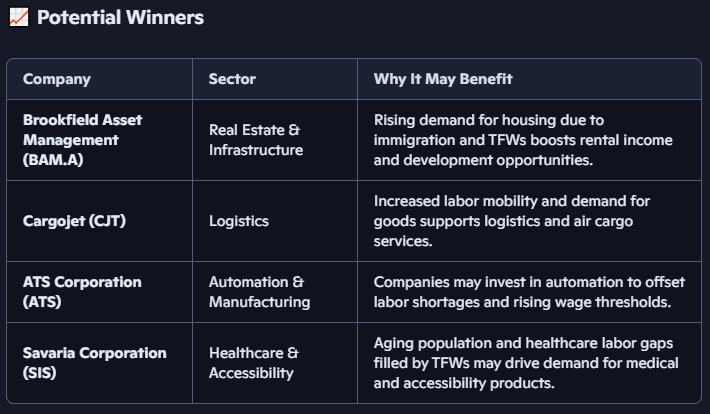
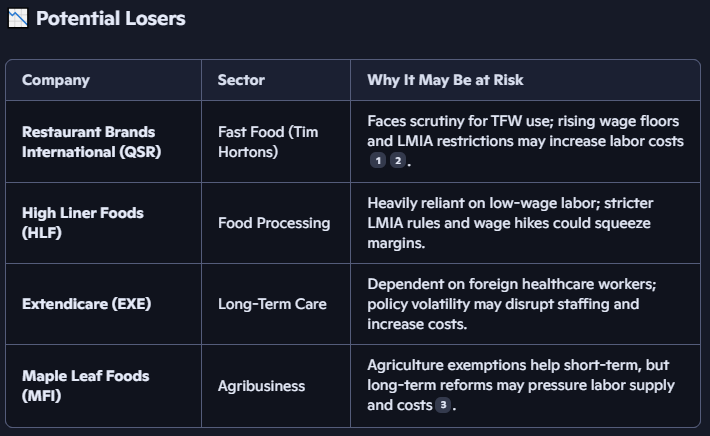
For investors, sectors reliant on TFWs offer short-term stability but face long-term risks. Diversifying into automation, affordable housing, and high-wage industries can help navigate Canada’s shifting economic landscape.
● Written with the help of Grok, an AI developed by xAI.
Consider joining DiviStock Chronicles’ Referral Program for more neat rewards!Please refer to the details of the referral program.
Footnotes
Statistics Canada. (2023, 2024). Temporary Foreign Workers in Canada. Retrieved from https://www.statcan.gc.ca/en/subjects-start/immigration_and_ethnocultural_diversity/temporary_foreign_workers
Statistics Canada. (2020). Distribution of Temporary Foreign Workers Across Industries. Retrieved from https://www150.statcan.gc.ca/n1/pub/45-28-0001/2020001/article/00028-eng.htm
Statistics Canada. (2023). Foreign Workers in Canada: Distribution of Paid Employment by Industry. Retrieved from https://www150.statcan.gc.ca/n1/pub/11-627-m/11-627-m2023071-eng.htm
Statistics Canada. (2024). Canada’s Population Estimates, First Quarter 2024. Retrieved from https://www150.statcan.gc.ca/n1/daily-quotidien/240619/dq240619a-eng.pdf
Canada Mortgage and Housing Corporation. (2025). Fall 2024 Housing Supply Report. Retrieved from https://www.cmhc-schl.gc.ca/professionals/housing-markets-data-and-research/market-reports/housing-market/housing-supply-report
Canada Mortgage and Housing Corporation. (2024). Historic Rental Supply Growth Raises Canada’s Vacancy Rate. Retrieved from https://www.cmhc-schl.gc.ca/media-newsroom/news-releases/2024/historic-rental-supply-growth-raises-canada-vacancy-rate
Employment and Social Development Canada. (2024). Minister Boissonnault Announces Further TFW Program Reforms. Retrieved from https://www.canada.ca/en/employment-social-development/news/2024/10/minister-boissonnault-announces-further-temporary-foreign-worker-program-reforms-to-better-protect-the-canadian-labour-market-and-workers.html
Employment and Social Development Canada. (2024). TFW Program LMIA Statistics 2024Q1–2025Q1. Retrieved from https://open.canada.ca/data/en/dataset/e8745429-21e7-4a73-b3f5-90a779b78d1e
Canadian Institute for Health Information. (2023). Health Workforce in Canada: In Focus. Retrieved from https://www.cihi.ca/en/health-workforce-in-canada-in-focus
Canada Mortgage and Housing Corporation. (2023). Rental Market Report, 2023. Retrieved from https://www.cmhc-schl.gc.ca/en/professionals/housing-markets-data-and-research/market-reports/rental-market-reports-major-centres
Angus Reid Institute. (2024). Immigration: Housing, Labour, and Economic Concerns. Retrieved from https://angusreid.org/immigration-housing-labour-economy/
Gross, D. M. (2016). The impact of the Temporary Foreign Worker Program on wages. Canadian Journal of Economics, 49(4), 1497–1528. Retrieved from https://econpapers.repec.org/article/cjeissued/v_3a49_3ay_3a2016_3ai_3a4_3ap_3a1497-1528.htm
Migrant Workers Alliance. (2024). Unheeded Warnings: COVID-19 and Migrant Workers in Canada. Retrieved from https://migrantworkersalliance.org/reports/
Picot, G., & Crossman, E. (2023). Canada’s Missing Workers: Temporary Residents Working in Canada. C.D. Howe Institute. Retrieved from https://www.cdhowe.org/public-policy-research/canada%E2%80%99s-missing-workers-temporary-residents-working-canada
CBC News. (2024). Canada Scales Back TFW Program. Retrieved from https://www.cbc.ca/news/canada/temporary-foreign-workers-program-overhaul-1.7176858
CBC News. (2024). UN Report on TFW Abuses. Retrieved from https://www.cbc.ca/news/canada/temporary-foreign-workers-abuse-un-report-1.7300233
CBC News. (2014). TFW Program Linked to Joblessness. Retrieved from https://www.cbc.ca/news/business/temporary-foreign-worker-program-unemployment-1.1397969
Singer, C. R. (2025). Canada’s Temporary Worker Numbers Have Already Exceeded 2025 Targets. Canada Immigration. Retrieved from https://immigration.ca/canadas-temporary-worker-numbers-have-already-exceeded-2025-targets
Radio Canada International. (2025). Poilievre Calls for Temporary Foreign Worker Program to Be Scrapped. Retrieved from https://ici.radio-canada.ca/rci/en/news/2189973/poilievre-calls-for-temporary-foreign-worker-program-to-be-scrapped