


For individuals seeking to learn about analyzing Exchange-Traded Funds (ETFs), I suggest reviewing my earlier post that explains the fundamentals of ETFs and the analysis process.

JPMorgan Equity Premium Income ETF (JEPI) - Snapshot
Overview
The JPMorgan Equity Premium Income ETF (JEPI) is an actively managed ETF that seeks to provide consistent premium income with lower volatility. It was launched on May 20, 2020, and is issued by JPMorgan Chase (JPM).
Investment Strategy
JEPI employs a defensive equity portfolio using a bottom-up fundamental research process. The strategy includes investing in large-cap U.S. stocks and employing a covered call strategy to generate distributable monthly income. Essentially, it sells options on the stocks it owns, effectively 'renting out' a portion of their potential upside in exchange for a steady stream of income, or a 'premium’.
Top Holdings
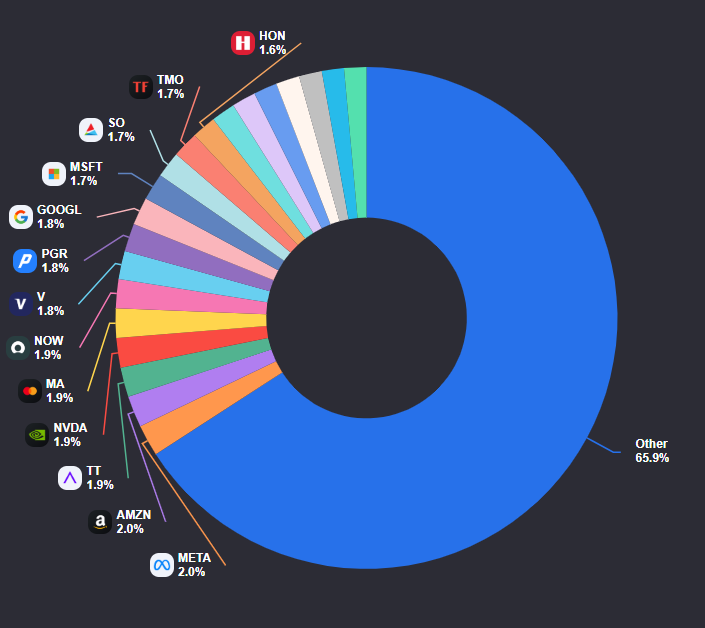
As of the latest data, the top holdings of JEPI include:
Sector Allocation
JEPI's sector allocation is diversified across various sectors, with a focus on technology, healthcare, and consumer discretionary sectors.
Risk Level
MEDIUM - due to its defensive strategy and focus on large-cap stocks, which typically offer more stability compared to small-cap stocks.
Performance
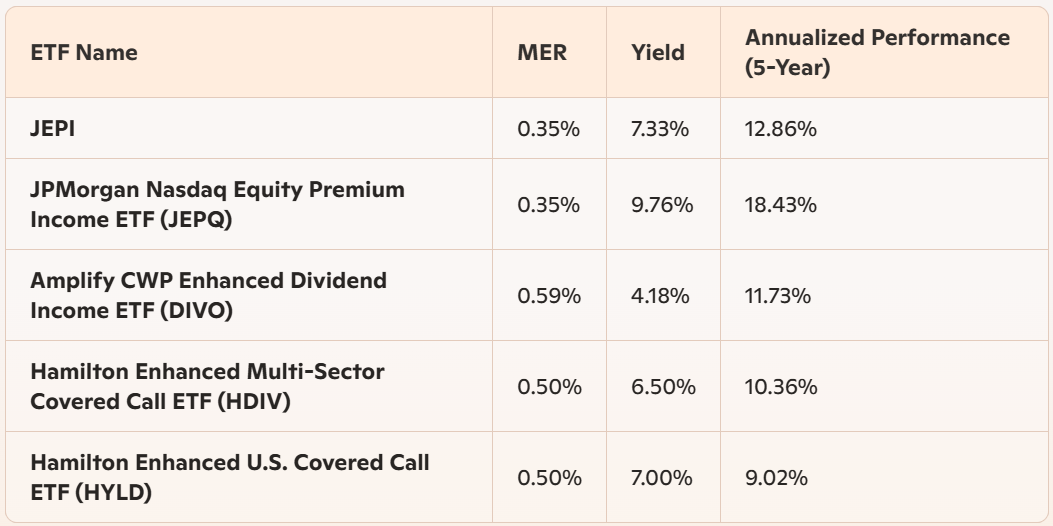
Since its inception, JEPI has provided an annualized return of approximately 12.92%.
Expense Ratio
The management expense ratio (MER) for JEPI is 0.35%, which is competitively priced compared to its peers
This means that for every $1,000 invested, the annual cost would be $3.50.
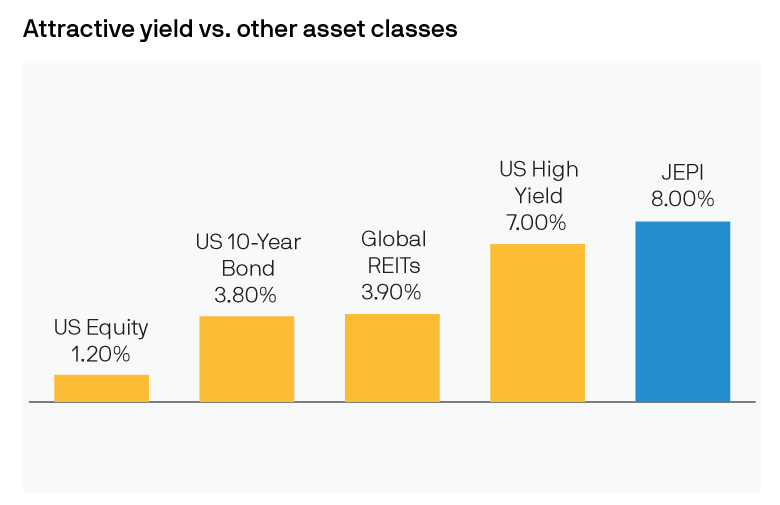
Dividend Yield
JEPI offers an attractive dividend yield. The average dividend yield for VTI has been around 7-8%.
This means that if you invest $1,000 in this ETF, you can expect to receive approximately $70 to $80 in dividends over a year, assuming the yield remains constant.
Similar Alternatives
Here are some alternatives to the JPMorgan Equity Premium Income ETF (JEPI) that also focus on generating income through similar strategies:
1. JPMorgan Nasdaq Equity Premium Income ETF (JEPQ)
Focus: Similar to JEPI but focuses on Nasdaq 100 stocks.
Strategy: Invests in Nasdaq 100 stocks and writes call options to generate income.
Yield: Comparable to JEPI, offering attractive monthly income.
2. Amplify CWP Enhanced Dividend Income ETF (DIVO)
Focus: Actively managed ETF combining dividends and option premiums.
Strategy: Seeks above-average yields with a combination of dividends and option premiums.
Yield: Offers a yield of 4.89%.
3. Hamilton Enhanced Multi-Sector Covered Call ETF (HDIV)
Focus: Canadian ETF that wraps eight other Canadian listed income-focused ETFs.
Strategy: Uses a covered call strategy to provide monthly distributions and target a higher-than-average annual yield.
Yield: Offers an annualized yield of 10.94%.
Sector Allocation: Focuses on financial and energy sector equities.
4. Hamilton Enhanced U.S. Covered Call ETF (HYLD)
Focus: U.S. equity-focused variant with a sector composition similar to the S&P 500.
Strategy: Uses a covered call strategy to enhance yields and potential returns.
Sector Allocation: Focuses on technology and healthcare equities.
This is a comparison of the JEPI ETF and similar alternatives, focusing on their Management Expense Ratios (MER), yields, and annualized performances.
Target Investors
The JPMorgan Equity Premium Income ETF (JEPI) targets income-seeking investors who are looking for consistent monthly income with lower volatility. This ETF is particularly appealing to:
Retirees: Individuals who need a steady income stream to supplement their retirement funds.
Conservative Investors: Those who prefer a more defensive investment strategy with reduced downside risk.
Income-focused Investors: Investors who prioritize high dividend yields and monthly income distributions.
Risk-Averse Investors: Investors who want to limit their exposure to market downturns while still participating in potential market gains.
Reason to Invest…
High Yield: JEPI offers an attractive yield. This can provide a steady income stream for investors.
Lower Volatility: The ETF employs a defensive strategy that aims to reduce volatility compared to the broader market. This makes it appealing to risk-averse investors.
Limited Downside Risk: The premium income can offset some of the potential losses if the stock price falls.
Monthly Income: JEPI distributes income monthly, which can be beneficial for retirees or those who need regular cash flow.
Active Management: The ETF is actively managed, which can help navigate market downturns and potentially outperform passive strategies in certain market conditions.
Diversification: JEPI invests in a diversified portfolio of large-cap U.S. stocks, providing exposure to various sectors.
Tax Efficiency: For U.S. investors, the ETF's income may be more tax-efficient compared to other high-yield investments, as qualified dividends are typically taxed at a lower rate.
Reason Not to Invest…
Lower Capital Appreciation: Due to its focus on income generation and lower volatility, JEPI may not perform as well in strong bull markets compared to growth-oriented ETFs.
Complex Strategy: The nuanced approach to covered calls can be complex and may not be suitable for all investors.
Capped Upside: Limits the potential upside by not fully participating in large market gains if the underlying stock price rises above the strike price.
Market Risk: Like all investments, JEPI carries market risk, and its performance can be affected by overall market conditions.
Counterparty Risk: The ETF's strategy involves counterparty risk, which is the risk that the other party in a financial transaction may default.
Performance Variability: While JEPI has performed well historically, its performance can vary, and it may not always meet investor expectations.

Consider joining DiviStock Chronicles’ Referral Program for more neat rewards!Please refer to the details of the referral program.