
PAVE - ETF Overview
A Comprehensive Guide to the Global X U.S. Infrastructure Development ETF (PAVE)

For individuals seeking to learn about analyzing Exchange-Traded Funds (ETFs), I suggest reviewing my earlier post that explains the fundamentals of ETFs and the analysis process.

Global X U.S. Infrastructure Development ETF (PAVE) - Snapshot
Overview
The Global X U.S. Infrastructure Development ETF (PAVE)1 is a U.S.-listed exchange-traded fund that provides targeted exposure to companies poised to benefit from increased domestic infrastructure spending.
Launched on March 6, 2017, PAVE tracks the Indxx U.S. Infrastructure Development Index, focusing on firms involved in construction, engineering, raw materials production, industrial transportation, and heavy equipment manufacturing. With assets under management surpassing $9.6 billion as of November 2025, it trades on the NYSE Arca exchange and has become a go-to vehicle for investors betting on America’s infrastructure renewal, driven by federal initiatives like the Infrastructure Investment and Jobs Act.
Investment Strategy
PAVE employs a passive, full-replication strategy to mirror the Indxx U.S. Infrastructure Development Index, investing at least 80% of its assets in index constituents. The index selects U.S.-listed companies deriving significant revenue from infrastructure-related activities, using a market-cap-weighted approach with annual reconstitution and quarterly rebalancing to maintain relevance. It emphasizes growth-oriented firms across the value chain—from materials suppliers to equipment providers—while capping individual holdings at 3% to promote diversification. The fund does not use leverage, derivatives, or active stock-picking, prioritizing cost efficiency and liquidity.
Top Holdings
PAVE’s portfolio comprises approximately 100 holdings. As of late October 2025, key positions include:
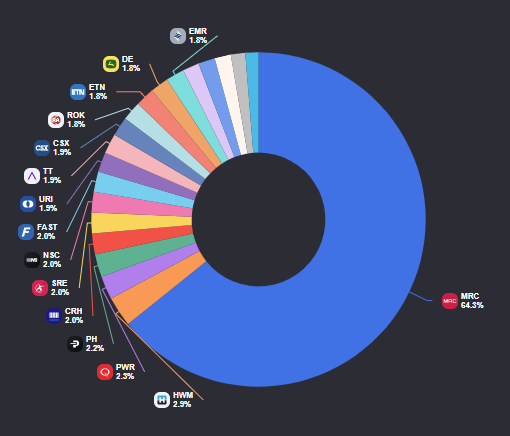
These selections highlight engineering, construction, and equipment firms, with frequent turnover limited by the index’s quarterly adjustments to reflect evolving infrastructure demands.
Sector Allocation
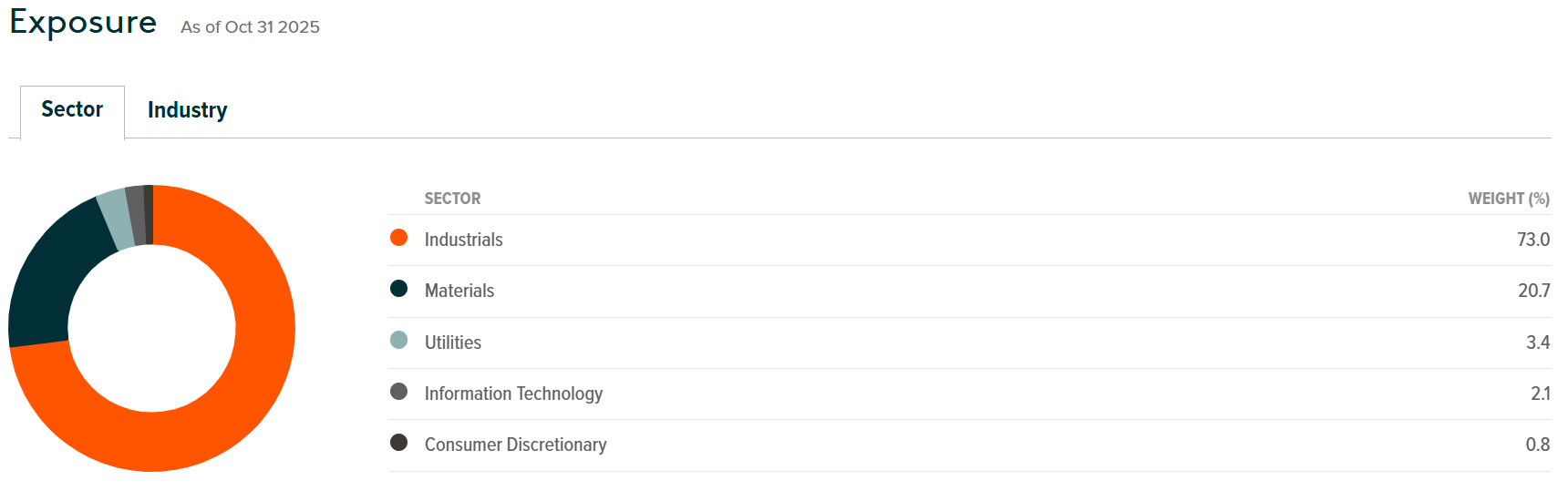
PAVE’s allocation tilts heavily toward cyclical sectors tied to physical development, providing broad but concentrated exposure to infrastructure themes.
Risk Level
MEDIUM-to-HIGH – due to its equity focus on cyclical industrials and materials, which are sensitive to economic cycles and policy shifts. Its three-year beta of 1.24 indicates amplified volatility relative to the S&P 500, with a standard deviation of approximately 23%, leading to potential drawdowns exceeding 40% in bear markets.
Key risks include commodity price swings affecting materials holdings, delays in government funding, and interest rate hikes that could elevate borrowing costs for infrastructure projects. Diversification across 100+ holdings mitigates single-stock risk, but sector concentration heightens vulnerability to construction slowdowns.
Performance
Since inception on March 6, 2017, PAVE has achieved an annualized total return of 14.91% as of November 14, 2025, net of fees and including reinvested dividends.
This was fueled by post-2021 infrastructure stimulus and industrial recovery.
Performance has been strongest during economic expansions (e.g., +60% in 2021), but lagged in high-rate environments like 2022 (-15%).
Expense Ratio
PAVE’s management expense ratio (MER) is 0.47% per annum. This positions it competitively among thematic infrastructure ETFs, where peers often exceed 0.50%.
This means that for every $1,000 invested, the annual cost would be $4.70.
Dividend Yield
PAVE’s historical average dividend yield since inception is approximately 0.55%, derived from semi-annual distributions totaling about $0.25 per share annually over the past three years.
This means that for every $1,000 invested, you can expect to receive approximately $5.50 in dividends over a year, assuming the yield remains constant.
Similar Alternatives
Investors seeking U.S. infrastructure exposure can explore these comparable ETFs, each with a domestic tilt but varying sector emphases:
IFRA - iShares U.S. Infrastructure ETF: Tracks the NYSE FactSet U.S. Infrastructure Index, blending utilities and industrials for broader stability and income.
IFIN - iShares U.S. Infrastructure Advance ETF: Actively managed for ESG-integrated infrastructure, focusing on sustainable development and innovation.
GII - SPDR S&P Global Infrastructure ETF: Provides global reach with heavy U.S. weighting, emphasizing utilities and transportation for diversified yield.
Target Investors
Growth-oriented thematic enthusiasts: Individuals passionate about secular trends like U.S. reindustrialization who want concentrated exposure without stock-picking.
Portfolio diversifiers seeking cyclical balance: Investors with heavy tech or consumer tilts aiming to add infrastructure as a hedge against inflation and supply chain shifts.
Long-term economic optimists: Those betting on federal policy continuity for roads, bridges, and energy grids to drive multi-year gains.
Income-growth hybrids: Moderate-risk takers desiring modest dividends alongside capital appreciation in a single, liquid vehicle.
Reason to Invest…
Thematic alignment with policy tailwinds: Captures bipartisan support for infrastructure bills, positioning holdings for sustained federal contracts and subsidies.
Diversified access to the value chain: Spans materials to machinery, reducing reliance on any single project type while amplifying upside from broad spending.
Strong historical outperformance: Has beaten broader markets in expansionary cycles, rewarding patience with compounded growth over volatility.
Liquidity for tactical allocation: High trading volume enables easy entry/exit, ideal for rotating into during economic recoveries.
Inflation resilience built-in: Cyclical holdings often pass through rising costs, providing a natural buffer against eroding purchasing power.
Cost-effective thematics: Competitive MER allows pure-play exposure without the premiums of niche mutual funds or direct investments.
U.S.-centric focus: Avoids global currency risks, appealing to domestic investors prioritizing American economic revival.
Scalable for all sizes: ETF structure suits retail to institutional scales, with no minimums beyond brokerage requirements.
Reason Not to Invest…
Cyclical vulnerability to downturns: Industrials-heavy portfolio amplifies recessions, leading to sharp drawdowns when construction halts.
Policy dependency risks: Gains hinge on sustained government funding, vulnerable to budget cuts or election shifts derailing initiatives.
Modest income generation: Low yield disappoints dividend seekers, prioritizing growth over reliable cash flow.
Interest rate exposure: Higher borrowing costs for projects can squeeze margins, underperforming in tightening monetary environments.
Concentration in few sectors: Over 90% in industrials and materials heightens sensitivity to commodity slumps or labor shortages.
Volatility exceeds broad indices: Beta above 1.0 means amplified swings, unsuitable for low-risk or short-term horizons.
No ESG screening: Lacks explicit sustainability filters, potentially conflicting with ethical investing mandates.
Opportunity cost in bull markets: May lag high-flying tech or healthcare during non-infrastructure booms.
● Research supported by Grok, built by xAI.