
SOXL - ETF Overview
A Comprehensive Guide to the Direxion Daily Semiconductor Bull 3X Shares (SOXL)

For readers who want a deeper introduction to how Exchange‑Traded Funds (ETFs) work and how to analyze them, I recommend checking out my earlier post that covers the core concepts and analysis framework.

Direxion Daily Semiconductor Bull 3X Shares (SOXL) - Snapshot
Overview
The Direxion Daily Semiconductor Bull 3X Shares (SOXL)1 is a high-octane, leveraged exchange-traded fund designed to provide aggressive tactical exposure to the U.S. semiconductor sector. Unlike traditional equity ETFs, SOXL does not track its index on a 1-to-1 basis; instead, it utilizes financial derivatives to deliver amplified movements. Due to the compounding effects of its daily leverage reset, it is intended strictly as a short-term trading vehicle rather than a long-term compounder.
Investment Strategy
SOXL seeks daily investment results, before fees and expenses, of 300% (or 3x) the daily performance of the NYSE Semiconductor Index. To achieve this aggressive amplification, the fund manager utilizes synthetic financial instruments—primarily equity swap agreements, futures contracts, and forward contracts with major financial institutions. The fund must rebalance its derivatives portfolio at the close of every single trading day to maintain its strict 3x leverage target. Consequently, multi-day returns will diverge significantly from a simple 3x multiplier of the index due to compounding and volatility decay.
Top Holdings
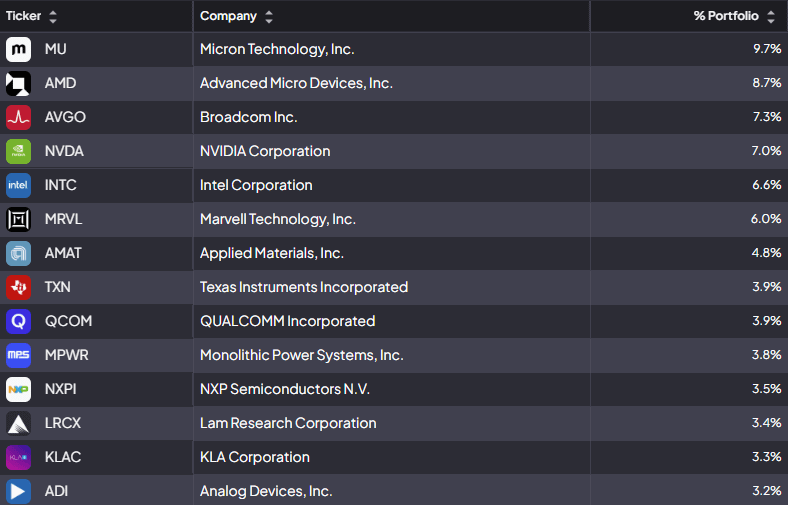
Because SOXL utilizes swaps to achieve its leverage, its actual counterparty contracts reflect massive synthetic exposure to the underlying index. The top physical equity components tracking the underlying index allocation include:
Sector Allocation
The fund features absolute concentration in a singular segment of the technology world:
Information Technology (Semiconductors & Semiconductor Equipment): 100.00%.
Risk Level
EXTREMELY HIGH – SOXL is classified at the absolute highest end of the risk spectrum. Daily 3x leverage means that a 10% drop in the underlying semiconductor index results in a 30% drop in SOXL's value within a single session. Over extended periods, the "volatility tax" (decay caused by daily mathematical compounding in choppy sideways markets) can result in severe and permanent capital loss, even if the underlying index finishes flat.
Expense Ratio
XEG’s management expense ratio (MER) is 0.91% per annum.
This means that for every $1,000 invested, the annual cost would be $9.10.
Dividend Yield
SOXL pays a very low yield of approximately 0.5%.
Distributions are nominal and paid out quarterly; the fund is completely structurally optimized for capital appreciation and day-trading rather than income generation.
This means that for every $1,000 invested, you can expect to receive approximately $5 in dividends over a year, assuming the yield remains constant.
Similar Alternatives
For Canadian investors seeking exposure to the semiconductor or hyper-growth tech space without navigating the structural decays of U.S. 3x leverage, the following three local options on the Toronto Stock Exchange (TSX) serve as viable alternatives:
iShares Semiconductor Index ETF (XCHP.TO): This Canadian-domiciled ETF tracks the same primary basket of U.S. chip manufacturing giants on a standard 1-to-1 unleveraged basis. It trades in CAD, providing simple, stable, pure-play exposure to companies like NVIDIA and AMD while entirely removing the threat of leverage decay.
Global X Artificial Intelligence Semiconductor Index ETF (CHPS.TO): Formerly a broad semiconductor tracker, CHPS evolved its mandate to track the PHLX US AI Semiconductor Index. It specifically isolates the hardware layer powering the artificial intelligence revolution, offering a concentrated, unleveraged CAD vehicle focused heavily on processing power and foundational design.
Global X NASDAQ-100 Index Corporate Class ETF (HXQ.TO): For investors wanting heavy tech exposure but worried about the extreme single-sector risk of semiconductors, HXQ tracks the broader NASDAQ-100 index. It features a highly tax-efficient corporate class swap structure designed specifically for non-registered Canadian taxable accounts, offering top chip stocks alongside larger software and internet conglomerates.
Target Investors
Day Traders: Active individuals who monitor intraday market movements continuously to scalp quick momentum shifts.
Swing Traders: Technical analysis professionals looking to capture sharp multi-day sector trends during clear bull runs.
Tactical Hedgers: Institutional or sophisticated investors using minor positions to leverage up overall portfolio exposure during secular breakout events.
High Risk-Tolerance Speculators: Capital allocators who understand derivatives structures and are willing to accept a total loss of principal for explosive asymmetric upside.
Reason to Invest…
Amplified Daily Returns: Offers three times the profit potential on successful daily directional bets within the chip sector.
Capital Efficiency Execution: Allows active traders to command a massive dollar value of exposure while tying up a fraction of their cash principal.
No Brokerage Margin Needed: Grants structural leverage straight through equity shares without triggering margin interest rates or broker margin calls.
Secular Industry Winds: Directly captures the exponential underlying growth generated by global artificial intelligence infrastructure demands.
Deep Liquidity Pools: Boasts massive average daily trading volume, facilitating seamless entry and exit executions via tight bid-ask spreads.
Institutional Structural Counterparties: Backed by institutional-grade swap arrangements that guarantee close tracking of the daily 3x index calculation.
Pure Hardware Isolation: Avoids broad software or social media tech clutter by isolating the fundamental manufacturing layer of global technology.
Asymmetric Breakout Weapon: Functions as an incredibly effective vehicle for maximizing alpha generation during confirmed macro cyclical upturns.
Reason Not to Invest…
Mathematical Volatility Decay: Suffers from compounding erosion in choppy or range-bound markets, destroying capital even if the index breaks even.
Extreme Drawdown Vulnerability: Experiences swift, crushing multi-percentage losses during standard market corrections or tech sector rotations.
Unsuitable for Long-Term Holding: Violates basic buy-and-hold investing principles due to the operational realities of the daily leverage reset mechanism.
Severe Single Sector Concentration: Exposes capital entirely to a single tech pocket without any stabilization from defensive stock sectors.
Counterparty Structural Risks: Relies on major institutional banks honoring derivative swap contracts, adding credit risk layers absent in physical asset funds.
Aggressive Industry Cyclicality: Remains tightly coupled to the historic boom-and-bust manufacturing demand waves inherent to chip foundries.
Premium Expense Drag: Costs significantly more than basic index options, draining fund net asset value rapidly during flat performance windows.
Geopolitical Supply Chain Friction: Vulnerable to immediate, unpredictable international policy shocks, export bans, and geographic vulnerabilities surrounding hardware production centers.
● Human-led analysis, Research supported by Google Gemini.