
Why Cycles Still Rule Everything: A Closer Look at Oil
From oil peaks to gold surges, understanding capital rotation is the real edge.

Market history has a way of repeating itself—not perfectly, but with enough rhyme to reward anyone paying attention. The patterns highlighted in Cycles, Crashes, and Comebacks make that point unmistakably. Across the dot‑com bust and the Global Financial Crisis, the same story emerges: while broad indices like the S&P 500 crumble under the weight of speculation or structural fragility, certain sectors continue to show strength, often long after the market peak.

Energy, in particular, stands out as the recurring outlier. In both 2000 and 2008, the XLE sector didn’t just hold up—it pushed to new highs even as the broader market rolled over. Materials, Utilities, and Consumer Staples also showed resilience, but energy was the common thread that defied the early stages of each downturn.
The deeper message is clear: sector rotation isn’t just a tactical tool—it’s a survival strategy. And when the dust settles after a crash, the sectors tied to real assets and cash‑flow stability often lead the recovery. Energy, Materials, Utilities, and strong dividend payers consistently reappear as the backbone of market comebacks.
But there’s a missing piece in this conversation—one that becomes even more important as we approach another late‑cycle environment.
⛽ Why We Need to Talk About Oil Prices Too
If energy repeatedly shows up as a leading indicator before, during, and after major market resets, then oil prices deserve a front‑row seat in the analysis.
Oil isn’t just another commodity. It’s a macro signal.
It reflects global demand strength or weakness.
It reacts to geopolitical tension faster than equities.
It influences inflation, interest rates, and corporate margins.
And historically, major moves in oil often precede broader market shifts.
When energy stocks outperform late in a cycle—as they did in 2000 and 2008—oil prices are usually telling a parallel story. Ignoring that data point would be like studying tides without looking at the moon.
As we evaluate where we stand today, taking a closer look at oil prices can help confirm whether we’re witnessing another classic end‑of‑cycle setup or something structurally different. It also helps frame the conversation around commodities more broadly, especially given how strongly they performed relative to equities in past downturns.
Top to Top, Before the Full Crash
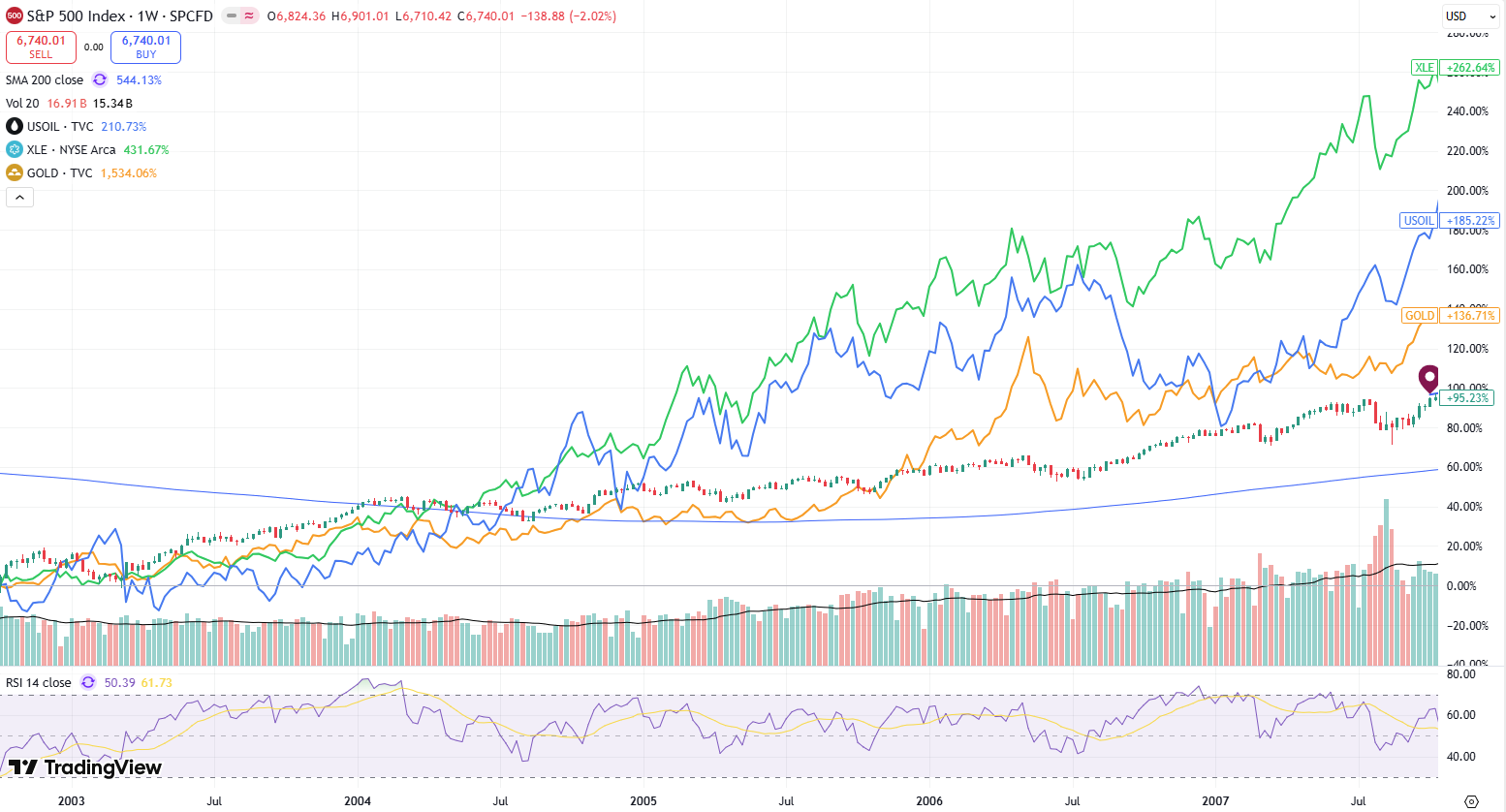
Believe it or not, the S&P 500’s peak in a cycle doesn’t always signal the high point for everything else. Certain sectors can continue hitting new highs for months afterward. From SPY’s peak to XLE’s (energy) eventual top, we explore how oil performed along the way.
2000 Recession
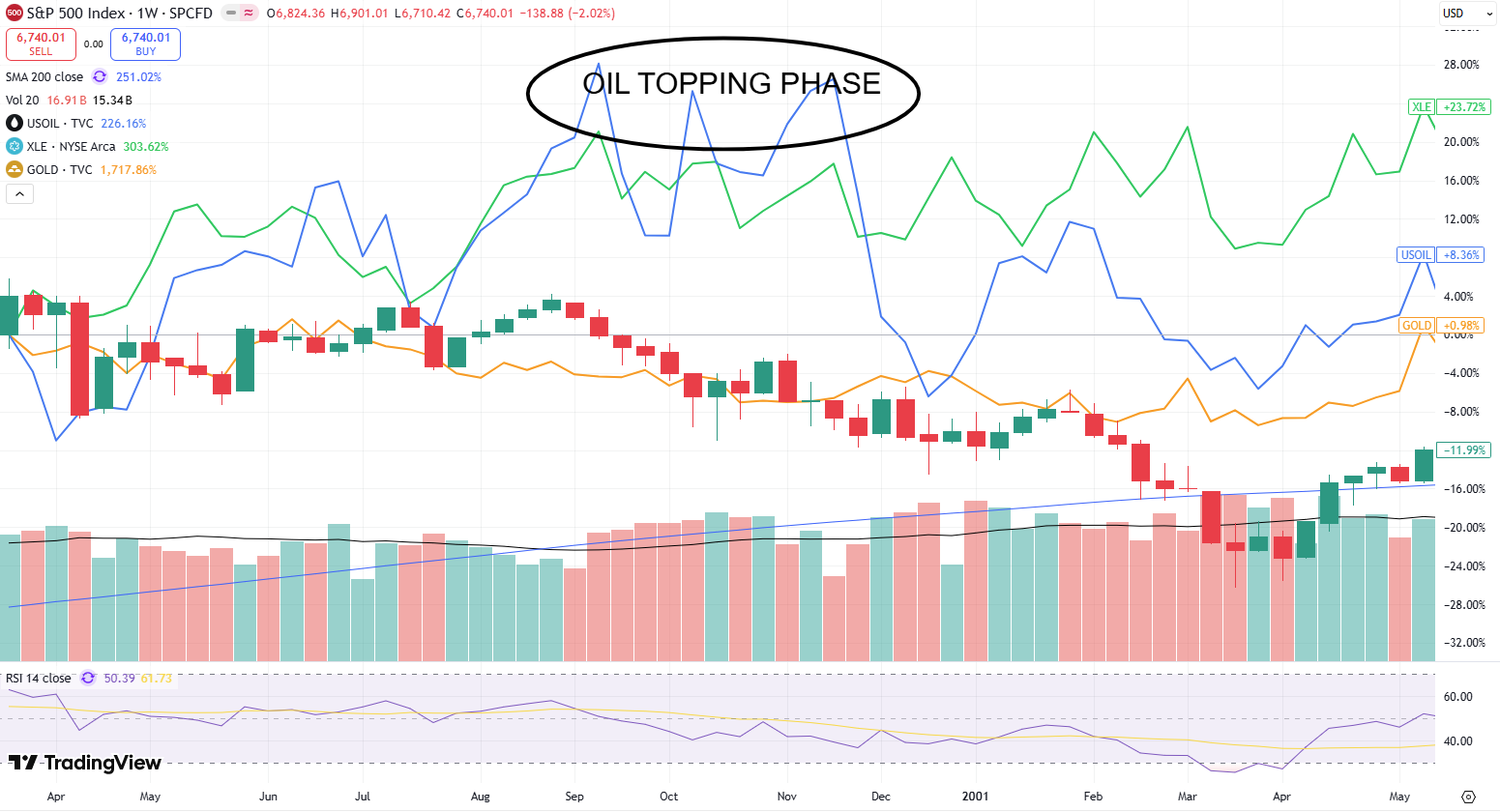
Oil prices were scraping along the bottom when the SPY peaked during the dot‑com era. From that point on, while the SPY drifted sideways, oil quietly began its ascent. And climb it did—roughly 27%—until its own topping phase between September and November of 2000. XLE continued. Gold, as a store of value, held steady.
Tell me that doesn’t feel eerily familiar today.
2008 Recession
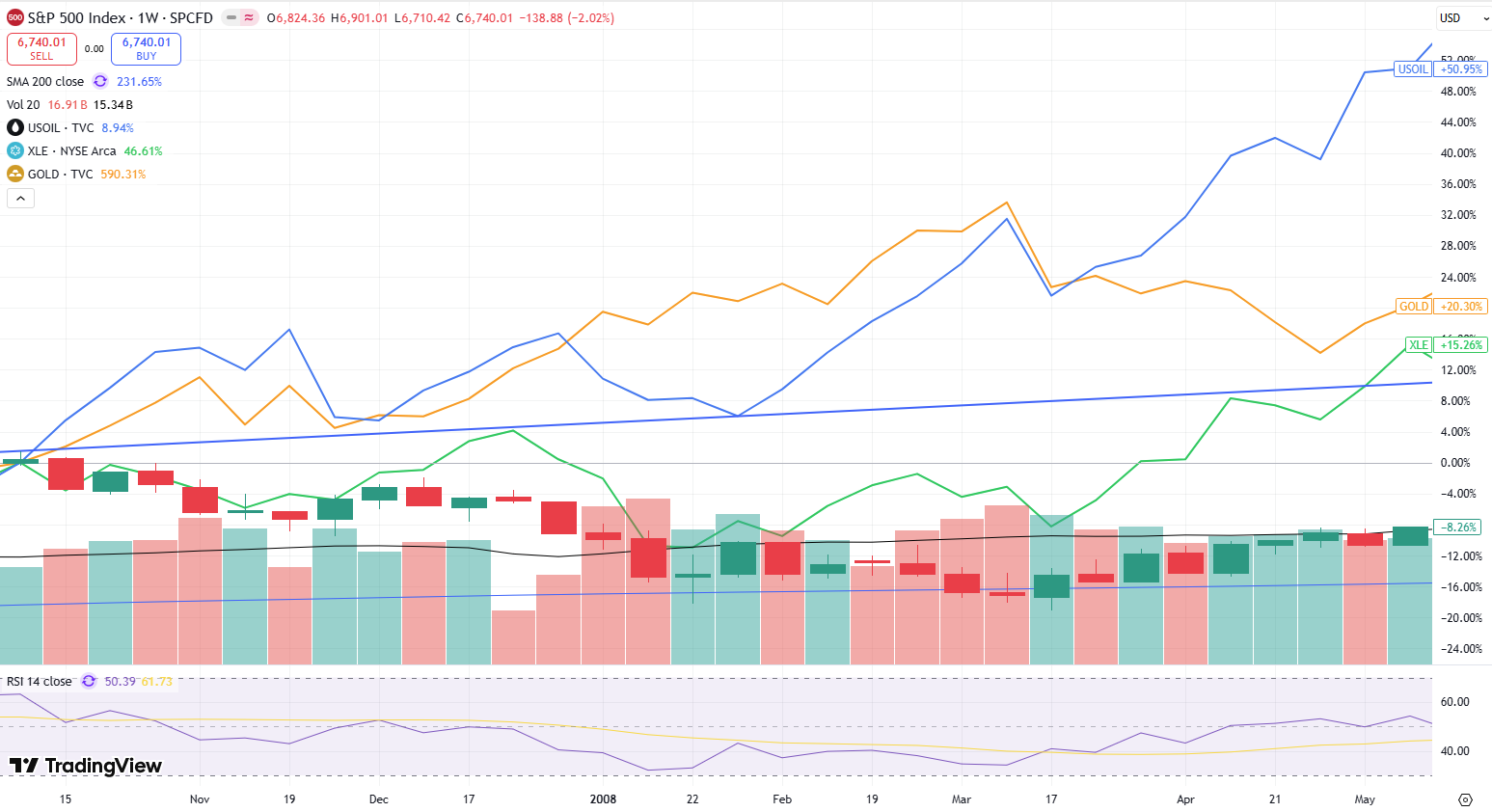
Speaking of which, oil prices went absolutely berserk in 2008. Both crude and the broader energy sector became the market’s high fliers once the SPY topped out. I’ll keep this one brief because the setup is strikingly similar to what we’re seeing unfold in today’s market. Oh, and gold, yes it still climbed a bit more. But has gold today already run its course in today’s market?
Final Sector High to the Bottom of the Barrel
Like I mentioned before, the time will come when everything crashes all at once. While some have already crashed, they will keep going down, now joined by the rest of the pack that pushed their limits further before finally giving in.
2000 Recession
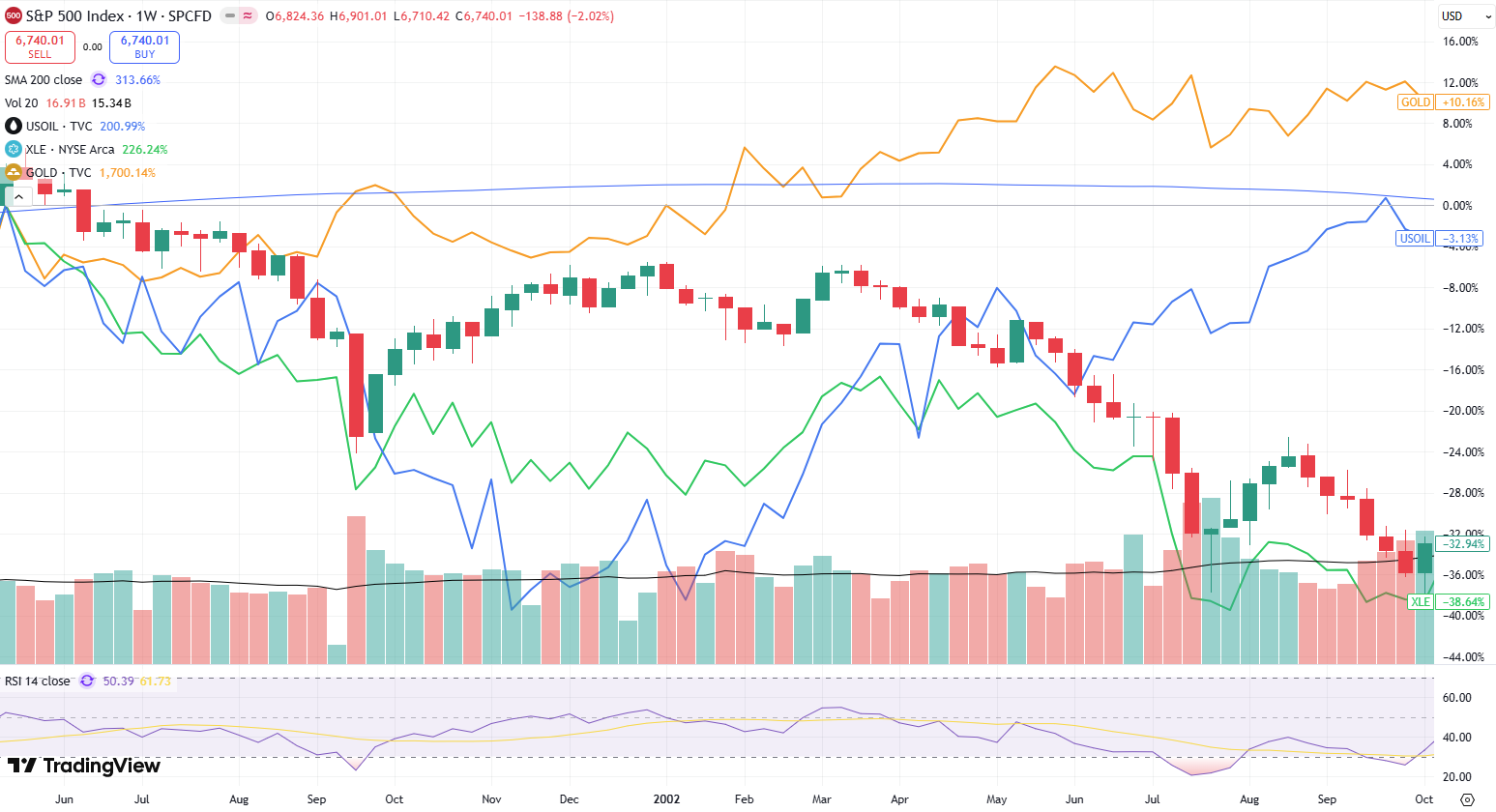
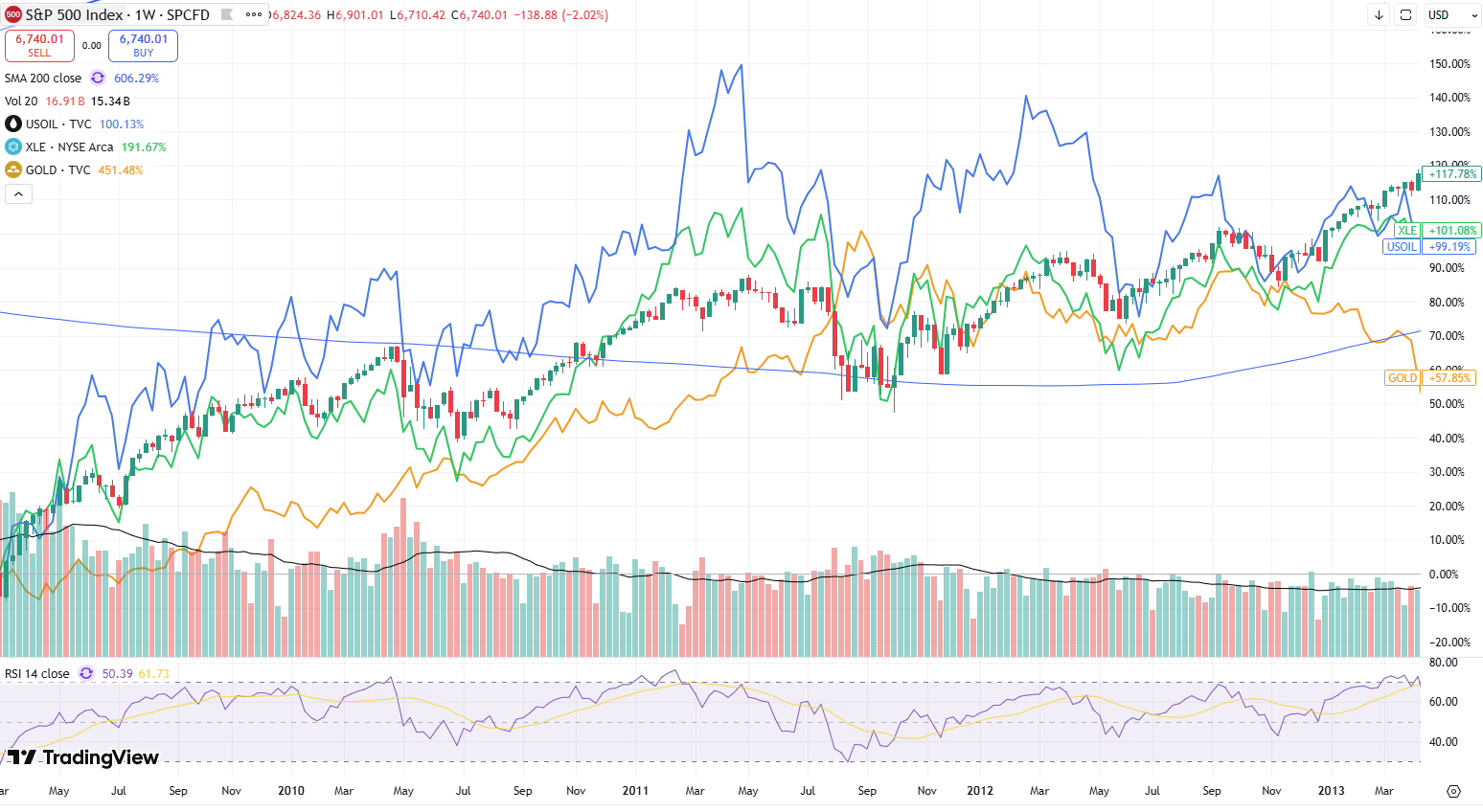
Once XLE and oil hit their highs, the move essentially dragged everything else—except gold—down the stairs. If you can spot the top in these assets or commodities, you can time your exit and rotate into gold. From that point forward, gold typically begins its historic runs, often outperforming its previous cycles.
2008 Recession
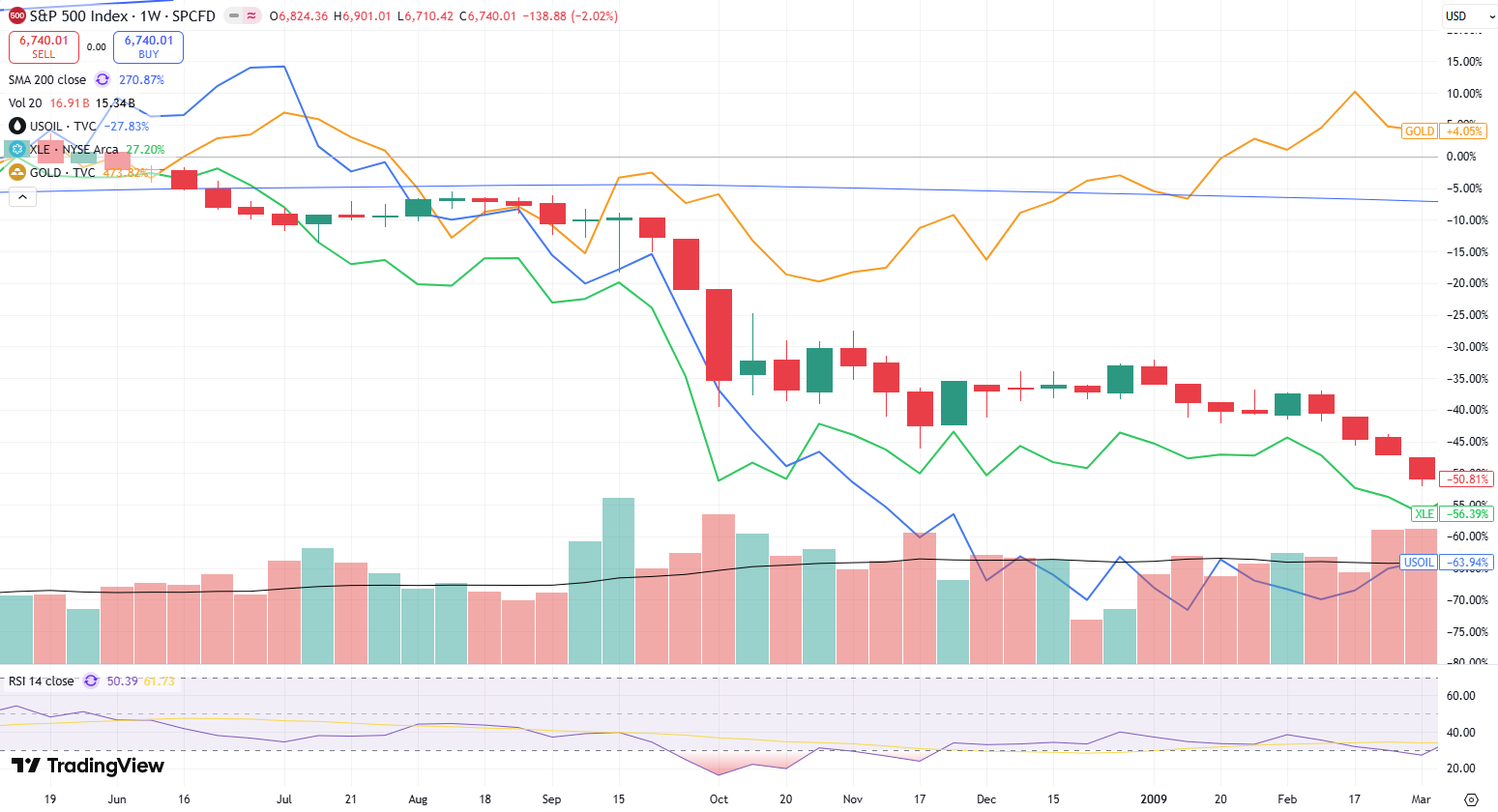
In a deep recession like the 2008 financial crisis, almost every corner of your portfolio gets hit—hard. But once again, what holds up? Gold. It remains the ultimate store of value when everything else is breaking down.
Cycles matter. When oil prices peak, the XLE sector typically tops out as well, and that’s often your signal to step aside. From there, capital tends to rotate to safe havens, and gold begins its strongest historical runs.
Bottom Low to New High
Identifying the true bottom of a cycle is often the hardest part. Every dip looks like a bargain—until it isn’t, and the market sinks even further. You never know how many false bottoms you’ll see along the way. But once the real bottom finally forms, risk assets begin to rise again, each with its own degree of strength and momentum.
2000 and 2008 Recession
At this stage of the cycle, the challenge becomes gauging how the economy will recover and what kind of growth it can realistically generate. Gold usually turns into the relative underperformer—still positive, but overshadowed as capital rushes back out along the risk curve.
If the next wave of artificial intelligence truly emerges, the question becomes: which sectors will lead? To answer that, you have to think about the inputs required to power that innovation. They’ll likely come from energy, materials, commodities, industrials, and related sectors. Those building blocks enable the next generation of powerful technology, and once again, the cycle resets.
Before Crash High to After Crash High
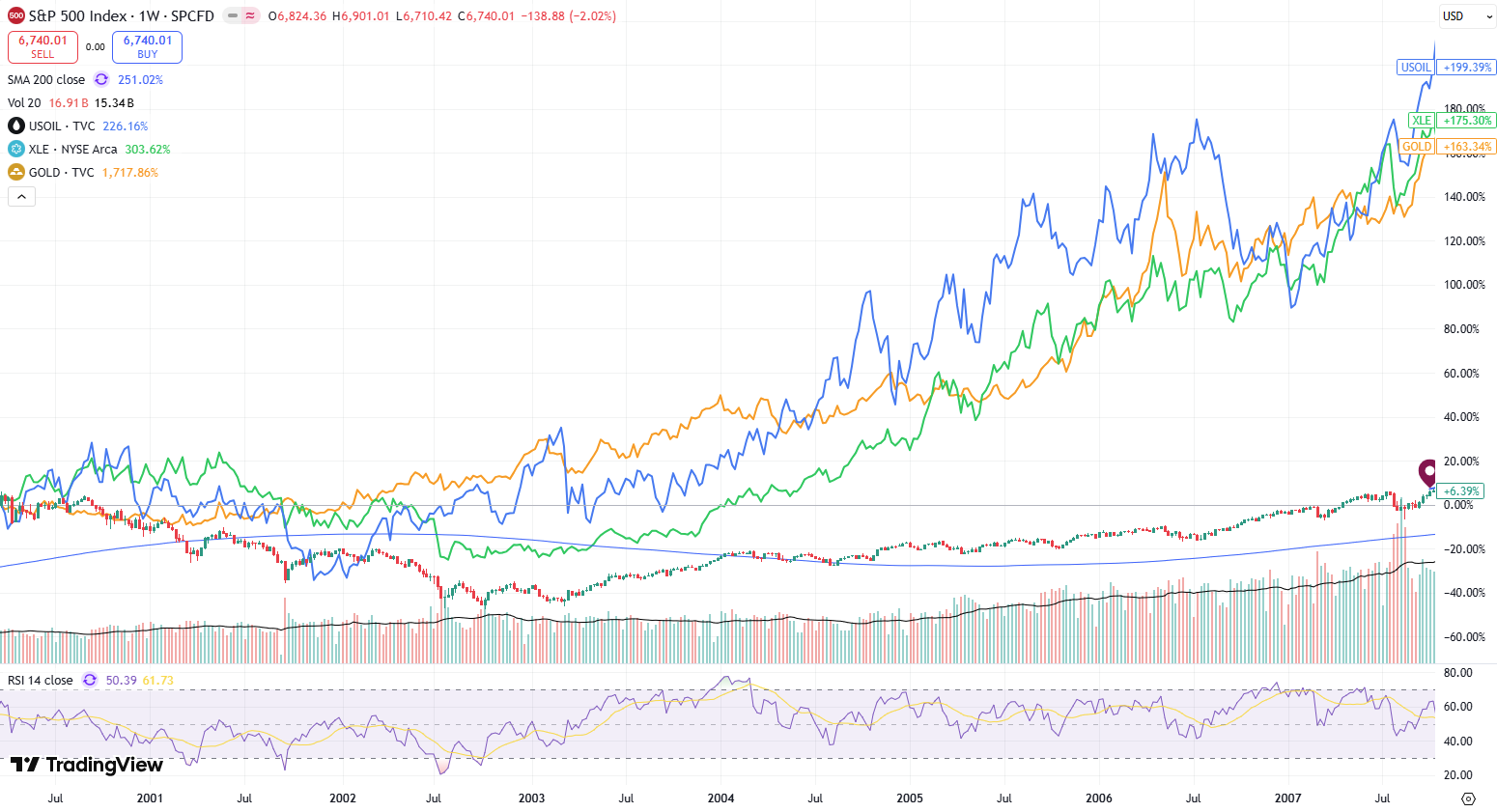
Buying at peak prices during a bubble or at the start of a shaky market cycle can lead to big losses and a tough, drawn-out recovery. Now, let’s drive this point home by factoring in oil prices.
2000 Recession
If you can hold select sectors or safe‑haven commodities through the major drawdowns, there’s a strong chance you’ll dramatically outperform the broad index funds over this period of the cycle. It is wise to identify where the bubble ends. Most investors stay parked in the main indices, even as they fall and grind sideways for long stretches. Meanwhile, other sectors quietly flourish. For those who understand these rotations, it becomes a genuine game‑changer.
2008 Recession
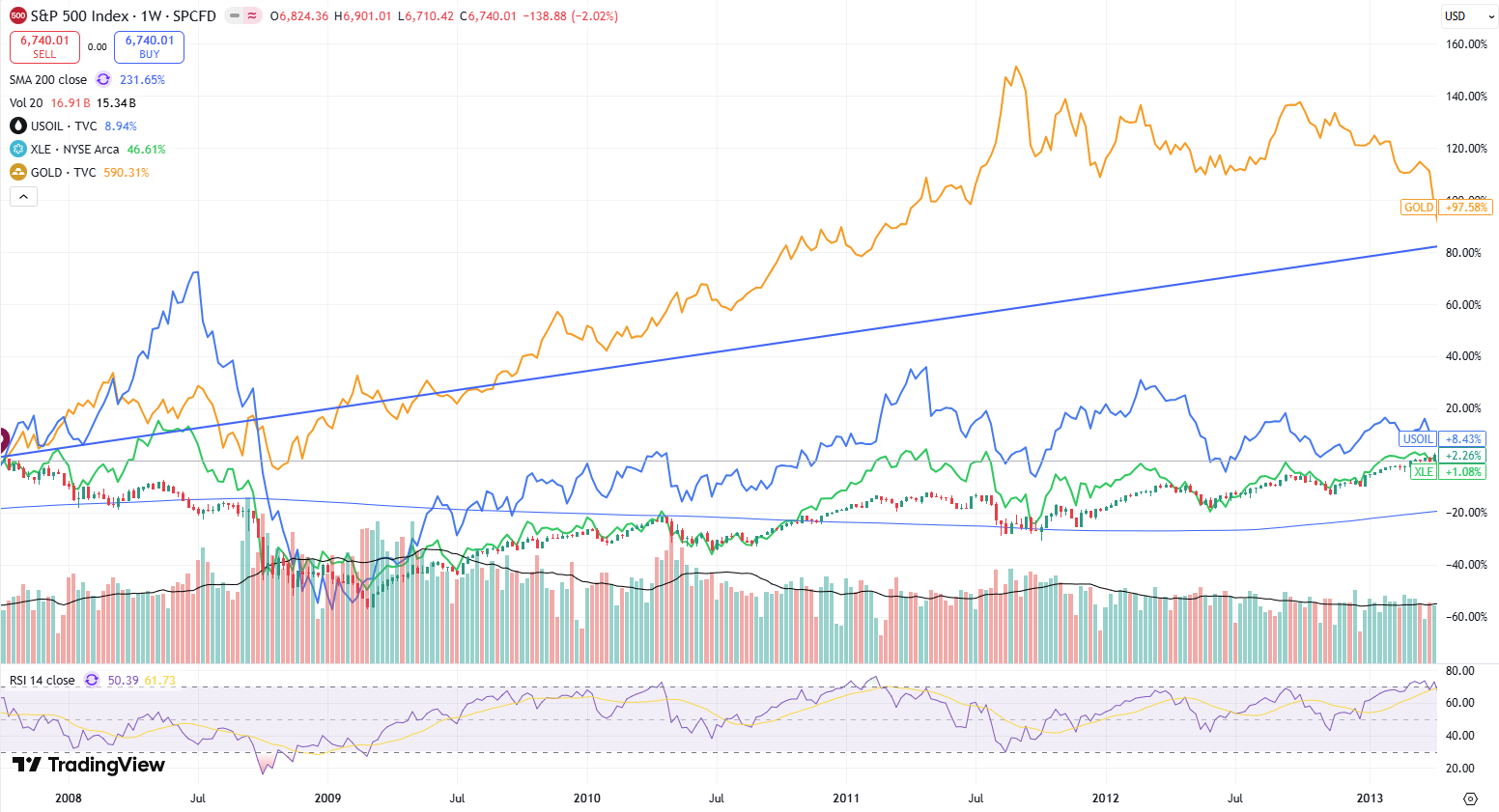
This chart makes the picture unmistakably clear. As major indices like the SPY reach their peak, commodities often enjoy one last surge before the full unwinding of the crash cycle. Just look at the oil price—violent upside swings that strain the entire system. That kind of energy shock tightens liquidity, slows economic activity, and ultimately sends markets into a freefall because no one can sustain those elevated costs.
And when you compare the recessionary periods above and below, one pattern stands out: gold is the only consistent winner in both environments. It really makes you wonder where gold could go once these patterns repeat themselves again.
Final Thoughts
Market cycles aren’t random—they’re rhythmic, structural, and deeply tied to how capital moves through the economy. When you understand those rotations, the chaos starts to look a lot more like opportunity. Energy peaks, liquidity tightens, risk assets unwind, and gold quietly becomes the anchor that holds its value through the storm. Then, as the cycle resets, new leadership emerges from the sectors that supply the raw inputs for the next wave of innovation.
Most investors stay trapped in the comfort of broad indices, riding them up and down without ever questioning the underlying cycle. But those who pay attention to the signals—commodity blow‑offs, sector rotations, liquidity shifts—position themselves far ahead of the crowd. The patterns have repeated for decades, and there’s little reason to believe they won’t continue.
If history is any guide, the next major transition will reward those who understand where we are in the cycle and act accordingly. Gold has proven its resilience time and time again. Energy and materials will likely power the next technological leap. And the investors who recognize these dynamics early will be the ones who benefit the most when the next chapter unfolds.