

XBM - ETF Overview
A Comprehensive Guide to the iShares S&P/TSX Global Base Metals Index ETF (XBM)

For individuals seeking to learn about analyzing Exchange-Traded Funds (ETFs), I suggest reviewing my earlier post that explains the fundamentals of ETFs and the analysis process.

iShares S&P/TSX Global Base Metals Index ETF (XBM) - Snapshot
Overview
The iShares S&P/TSX Global Base Metals Index ETF (XBM)1 is an exchange-traded fund that provides investors with exposure to companies involved in the production or extraction of base metals, such as copper, nickel, and zinc.
It aims to replicate the performance of the S&P/TSX Global Base Metals Index, which includes global mining companies with North American equity listings. It is suitable for those looking to gain targeted access to the base metals sector amid growing demand from industries like renewable energy and infrastructure.
Investment Strategy
XBM employs a passive investment strategy, seeking to track the S&P/TSX Global Base Metals Index net of expenses. The index is market-cap weighted and focuses on companies primarily engaged in base metals mining and production. The ETF uses full physical replication, holding the underlying securities in proportions that mirror the index. This approach provides direct exposure to the performance of base metals producers without active stock selection, aiming for long-term capital growth driven by commodity prices and mining company fundamentals.
Top Holdings
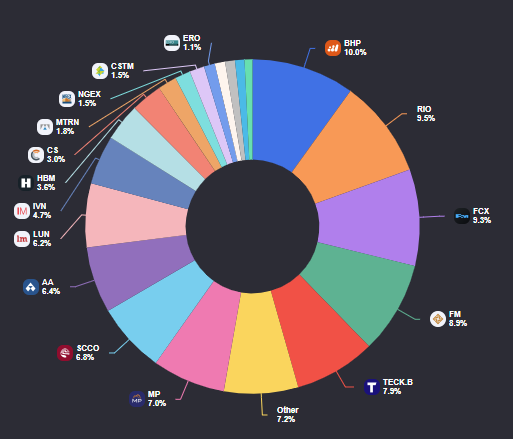
The top 10 holdings account for approximately 77% of the ETF's total assets. These include major global mining companies:
BHP Group Ltd (BHP) - A leading global resources company engaged in the exploration, development, production, and marketing of minerals like iron ore, copper, and coal.
Rio Tinto Group (RIO) - A multinational mining corporation specializing in aluminum, copper, diamonds, iron ore, and other minerals.
Freeport-McMoRan Inc. (FCX) - A major international mining company focused on copper, gold, and molybdenum production.
First Quantum Minerals Ltd. (FM.TO) - A Canadian-based mining and metals company with operations in copper, nickel, gold, and zinc across multiple continents.
Teck Resources Ltd Class B (TECK.B.TO) - A diversified Canadian resource company producing copper, zinc, and steelmaking coal.
Sector Allocation
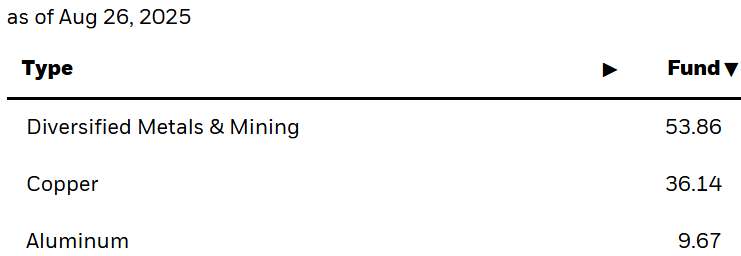
The ETF is heavily concentrated in the basic materials sector, with 100% allocation to materials, reflecting its focus on base metals mining and production. Geographic breakdown includes a majority in Canadian equity and U.S. equity with the remainder in international equity.
Risk Level
MEDIUM-to-HIGH – due to commodity price fluctuations, geopolitical risks in mining regions, and economic cycles affecting industrial demand.
Performance
Since its inception on April 12, 2011, XBM has delivered an annualized return of 2.64% as of August 2025.
Expense Ratio
XBM’s management expense ratio (MER) is 0.60% per annum.
This means that for every $1,000 invested, the annual cost would be $6.
Dividend Yield
Approximately 1.5% over the past 10 years, based on variable semi-annual distributions influenced by the underlying mining companies' payouts and commodity cycles.
This means that for every $1,000 invested, you can expect to receive approximately $15 in dividends over a year, assuming the yield remains constant.
Similar Alternatives
Three similar alternatives to XBM include:
Global X Copper Miners ETF (COPX): Focuses on copper mining companies globally, providing targeted exposure to a key base metal.
SPDR S&P Metals & Mining ETF (XME): Offers broad exposure to U.S.-listed metals and mining companies using a modified equal-weight approach.
iShares MSCI Global Metals & Mining Producers ETF (PICK): Tracks global metals and mining producers, excluding gold and silver, with a focus on large-cap companies.
Target Investors
Growth-oriented investors: Seeking sector-specific exposure to base metals with a bullish outlook on industrial commodities.
Diversified portfolio holders: Looking for tactical allocation to the materials sector within a broader investment strategy.
Commodity traders: Interested in gaining exposure to base metals without direct commodity trading.
Inflation hedgers: Using mining equities as a hedge against inflationary pressures.
Long-term holders: Focused on global economic trends like the energy transition and infrastructure development.
Risk-tolerant investors: Comfortable with higher volatility for potential sector-driven returns.
Reason to Invest…
Direct Sector Exposure: Provides direct exposure to the base metals sector, which benefits from increasing global demand in infrastructure and technology.
Diversification Benefits: Offers diversification away from traditional equity markets by focusing on commodity-linked assets.
Growth Potential: Potential for capital appreciation during economic expansions and commodity supercycles.
Cost Efficiency: Low-cost passive management reduces fees compared to active funds in the sector.
Liquidity Advantage: High liquidity allows for easy entry and exit through exchange trading.
Inflation Protection: Acts as an inflation hedge, as metal prices often rise with inflationary pressures.
Simplified Access: Access to a basket of global mining leaders without needing to pick individual stocks.
Green Transition Opportunity: Opportunity to capitalize on the green energy transition, where base metals are essential for renewables.
Reason Not to Invest…
High Volatility: High volatility due to sensitivity to fluctuating commodity prices and supply disruptions.
Economic Sensitivity: Exposure to economic downturns, as base metals demand drops in recessions.
Geopolitical Risks: Geopolitical risks from operations in unstable regions affecting mining companies.
Regulatory Pressures: Environmental and regulatory pressures on the mining industry could impact returns.
Currency Fluctuations: Currency fluctuations, especially for non-Canadian holdings, may add uncertainty.
Sector Concentration: Concentration in a single sector limits diversification within the ETF itself.
Inconsistent Dividends: Potential for inconsistent dividends, as mining payouts vary with profits.
Technological Shifts: Susceptibility to technological shifts that could reduce demand for certain metals.

Consider joining DiviStock Chronicles’ Referral Program for more neat rewards!Please refer to the details of the referral program.
Good overview. What stands out to me is that XBM’s long-term return (2.6% annualized) has lagged inflation. That makes it more of a tactical play on commodity cycles than a true core holding.
I follow XME, XLB. XBM.. I am not aware of.. will definitely take a look