
XDIV - ETF Overview
A Comprehensive Guide to the iShares Core MSCI Canadian Quality Dividend Index ETF (XDIV)

For readers who want a deeper introduction to how Exchange‑Traded Funds (ETFs) work and how to analyze them, I recommend checking out my earlier post that covers the core concepts and analysis framework.

iShares Core MSCI Canadian Quality Dividend Index ETF (XDIV) - Snapshot
Overview
The iShares Core MSCI Canadian Quality Dividend Index ETF (XDIV)1 is a low-cost, targeted Canadian equity fund designed to give investors exposure to high-quality, dividend-paying Canadian companies. Managed by BlackRock, XDIV seeks to track the performance of the MSCI Canada High Dividend Yield 10% Security Capped Index. Unlike traditional high-dividend ETFs that simply buy the highest-yielding stocks regardless of risk, XDIV specifically screens for corporate financial stability, strong balance sheets, and steady dividend growth potential.
Investment Strategy
XDIV utilizes a passive physical replication strategy, investing directly in Canadian dividend-paying equities that meet strict screening criteria established by MSCI. The underlying index focuses on two major pillars:
Quality Screening: Companies are selected based on strong fundamentals, low earnings volatility, and sustainable debt levels to avoid “yield traps.”
Dividend Screening: Eligible stocks must possess above-average dividend yields and a track record of consistent or growing dividend payments.
To manage single-stock concentration risk, the index applies a strict 10% security cap per issuer at each rebalancing interval, ensuring no single company dominates the fund’s portfolio weight.
Top Holdings
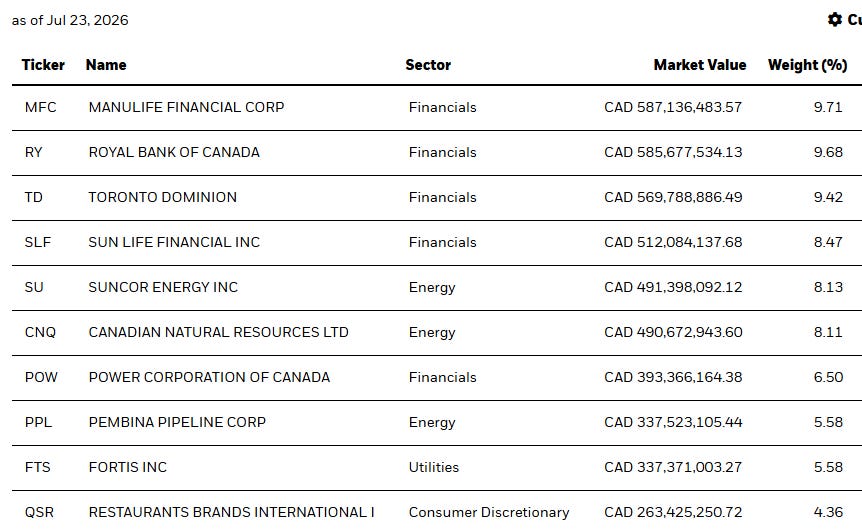
Because XDIV caps individual securities at 10% and screens for balance sheet quality, its top holdings represent blue-chip Canadian market leaders primarily spanning the financial, energy, and utility sectors:
Sector Allocation
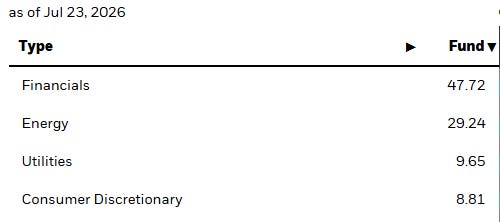
XDIV is heavily concentrated in defensive and cash-flow-rich sectors typical of the Canadian economy:
Risk Level
MEDIUM - While XDIV is a 100% equity fund—exposing it to standard stock market volatility—its focus on high-quality blue-chip stocks with steady cash flows makes it historically less volatile than broader Canadian market index funds or small-cap equity funds.
Expense Ratio
XDIV’s management expense ratio (MER) is 0.11% per annum.
This means that for every $1,000 invested, the annual cost would be $1.10.
XDIV is one of the cheapest dividend-focused ETFs available in Canada, making it a cost-effective core holding.
Dividend Yield
Historically, XDIV's yield has fluctuated between 3.1% and 5.5%, depending on broader market valuations and economic conditions. Paid on a monthly basis.
During market pullbacks or rate-hike environments, the ETF’s yield expanded toward the 4.8%–5.5% upper band. Conversely, during strong equity bull runs where share prices outpace payout increases, the yield trends closer to its current ~3.1% level.
This means that for every $1,000 invested, you can expect to receive approximately $30 to $55 in dividends over a year.
Similar Alternatives
Vanguard FTSE Canadian High Dividend Yield Index ETF (VDY)
VDY is XDIV’s most direct competitor. While XDIV screens for financial quality, VDY simply tracks the highest dividend yields in Canada. This gives VDY a slightly higher financial sector weighting (over 55%), whereas XDIV offers a marginally more balanced sector exposure due to its 10% holding cap.
BMO Canadian High Dividend ETF (ZDV)
ZDV utilizes an active-rules-based methodology that considers dividend growth, yield, and payout ratio. Unlike XDIV, ZDV holds more mid-cap stocks and distributes its weight across roughly 50 holdings, offering broader diversification than XDIV’s concentrated ~20-25 stock portfolio.
iShares Canadian Select Dividend Index ETF (XEI)
Also offered by BlackRock, XEI targets a broader mix of ~75 Canadian dividend stocks without XDIV’s explicit “quality” filters. XEI has higher exposure to energy and telecommunications stocks, whereas XDIV favors large-cap Canadian banks and financials.
Target Investors
Income-Seeking Investors: Individuals who rely on regular, predictable cash flow to fund living expenses or supplement salary.
Retirees and Pre-Retirees: Investors looking for lower-volatility equity exposure that generates reliable monthly distributions without drawing down principal.
Core Dividend Growth Investors: Long-term wealth builders who prefer high-quality Canadian companies with strong balance sheets that consistently increase payouts.
Cost-Conscious Canadian Investors: Fee-sensitive accounts seeking an institutional-grade, low-cost ETF as a portfolio foundation.
Tax-Efficient Account Holders: Investors building income streams within TFSA or RRSP registered accounts to benefit from tax-sheltered monthly dividend compounding.
Reason to Invest…
Financial Quality Focus: Filters out financially distressed companies by explicitly selecting businesses with low debt and steady earnings.
Ultra-Low Fee Structure: Among the cheapest dividend ETFs in the Canadian market, allowing investors to keep more of their investment returns.
Monthly Distribution Income: Provides cash flow every single month, making cash planning simpler for lifestyle expenses or dollar-cost averaging.
Single-Stock Capping: The 10% maximum stock cap prevents a single company from over-dominating the portfolio performance.
Core Blue-Chip Exposure: Composed of established, dominant Canadian brands that form the backbone of the domestic economy.
Mitigated Yield Traps: Avoids stocks that have artificially high yields solely because their share price has plummeted due to business distress.
DRIP Capability: Fully supports automatic dividend reinvestment programs, making compounding effortless over time.
Eligible for Registered Accounts: Works seamlessly across TFSAs, RRSPs, RESPs, and FHSAs for maximum tax efficiency.
Reason Not to Invest…
Heavy Sector Concentration: High combined exposure to Financials and Energy leaves the fund vulnerable to localized cyclical downturns.
Limited Number of Holdings: Holds roughly two dozen stocks, offering significantly less diversification than broad market indices like XIC or VCN.
No International Exposure: Focuses exclusively on domestic Canadian stocks, missing growth opportunities in US and global markets.
Tech Sector Underrepresentation: Virtually zero exposure to high-growth technology sectors, which can result in underperformance during tech-led bull markets.
Dividend Tax Drag in Non-Registered Accounts: Holding high-yielding domestic equities in taxable accounts can create annual tax burdens compared to growth-oriented index funds.
Interest Rate Sensitivity: High exposure to capital-intensive sectors like Utilities and Pipelines makes the underlying stock prices sensitive to interest rate fluctuations.
Underperformance in Growth Cycles: Quality dividend strategies typically lag behind broad-market funds during aggressive speculative stock rallies.
Currency and Geographic Dependency: Leaves an investor’s portfolio tied directly to the economic health and currency valuation of the Canadian market.
● DiviStock Chronicles is built for people who want to grow their wealth through dividend investing but don’t want to get lost in jargon or hype. My goal is simple: break things down clearly, stay honest about the risks, and help you build confidence as you navigate your own financial path. All analysis is human‑led, supported by AI tools like Microsoft CoPilot, Google Gemini, and xAI’s Grok, but the perspective is grounded in real‑world experience and common sense.