


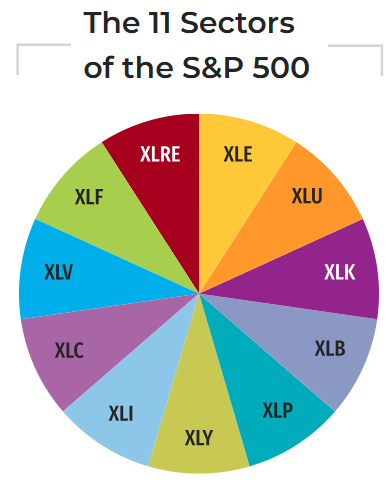
In this series on exchange-traded funds (ETFs), I will examine each of the Select Sector SPDR (Standard & Poor’s Depositary Receipts) Funds. Managed by State Street Global Advisors (SSGA), this family of ETFs allows investors to tailor their exposure to specific segments of the S&P 500 Index. Each fund represents a different sector of the index, as illustrated below, and is designed to track the performance of that sector.
For individuals seeking to learn about analyzing Exchange-Traded Funds (ETFs), I suggest reviewing my earlier post that explains the fundamentals of ETFs and the analysis process.
Analyzing an ETF

An Exchange-Traded Fund (ETF) serves as both an investment product and a collective investment scheme. Let’s break down what this entails:
Energy Select Sector SPDR Fund (XLE) - Snapshot
Overview
The Energy Select Sector SPDR Fund (XLE) is an exchange-traded fund (ETF) that tracks the performance of the S&P Energy Select Sector Index. It primarily focuses on U.S.-based energy companies, including those involved in oil, gas, and energy equipment and services.
Investment Strategy
XLE employs a passive investment strategy, aiming to replicate the price and yield performance of the Energy Select Sector Index. The fund uses a full replication approach, investing at least 95% of its total assets in the securities that make up the index. These securities are selected from the S&P 500 and classified as energy companies under the Global Industry Classification Standard (GICS). The portfolio is weighted by market capitalization, with a quarterly rebalancing process that caps any single holding at 25% to maintain diversification. This strategy provides investors with broad, market-like exposure to the energy sector, favoring large-cap firms while avoiding the total market’s smaller, riskier players.
Top Holdings
As of the latest data, the top holdings of XLE include:
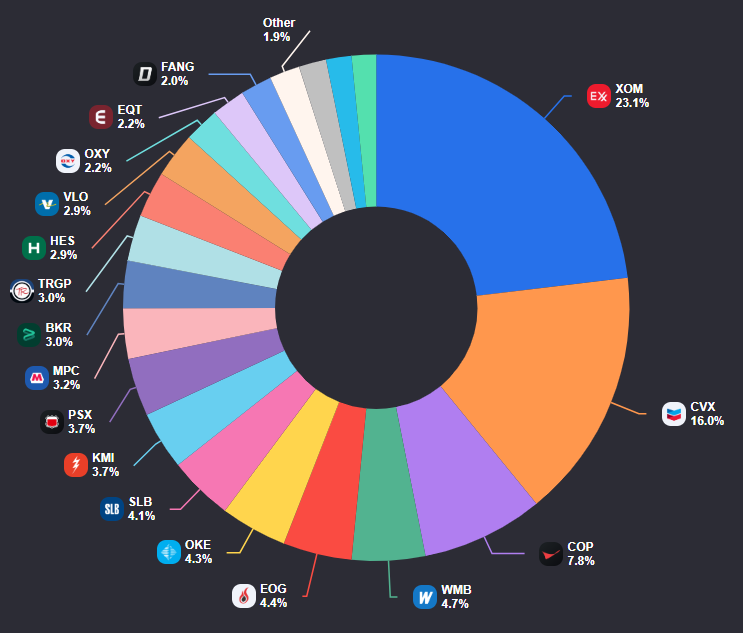
The top holdings typically include industry giants such as:
Exxon Mobil Corporation (XOM): A leading integrated oil and gas company.
Chevron Corporation (CVX): Another major player in oil and gas exploration and production.
ConocoPhillips (COP): Focused on upstream oil and gas activities.
Schlumberger Limited (SLB): A prominent energy equipment and services provider.
EOG Resources, Inc. (EOG): A key independent oil and gas exploration company.
The portfolio typically includes 20-30 holdings, reflecting its focus on the largest and most influential energy firms.
Sector Allocation
XLE is exclusively allocated to the energy sector. Within this sector, the fund’s investments span:
Oil, Gas & Consumable Fuels: The dominant sub-sector, including integrated oil companies, exploration and production firms, and refining and marketing entities (approximately 90%+ of the portfolio).
Energy Equipment & Services: Companies providing drilling, equipment, and technical services to the energy industry (typically around 5-10%).
Risk Level
HIGH - due to its concentrated exposure and the inherent volatility of the energy sector. Factors such as fluctuating oil prices, geopolitical events, economic sensitivity, and regulatory changes can significantly impact its performance. Additionally, its non-diversified nature increases volatility compared to broader market ETFs.
Performance
Since its inception on December 16, 1998, XLE’s annualized performance reflects the energy sector’s cyclical nature. The annualized return since inception is approximately 7-8%, assuming reinvestment of dividends. This figure varies with energy market cycles:
Strong gains during periods of rising energy prices (e.g., early 2000s, post-2020 recovery).
Notable declines during energy market slumps (e.g., 2014-2016 oil price crash, 2020 pandemic).
The fund’s long-term returns reflect the boom-and-bust nature of the energy sector, outperforming in bullish commodity cycles and lagging during bearish phases.
Expense Ratio
XLE has a low MER of 0.08%, making it a cost-effective option for investors seeking exposure to the energy sector.
This means that for every $1,000 invested, the annual cost would be $0.80.
Dividend Yield
The ETF offers an attractive dividend yield, averaging around 3.2%-3.5%. Dividends are distributed quarterly.
This means that if you invest $1,000 in this ETF, you can expect to receive approximately $32 to $35 in dividends over a year, assuming the yield remains constant.
Similar Alternatives
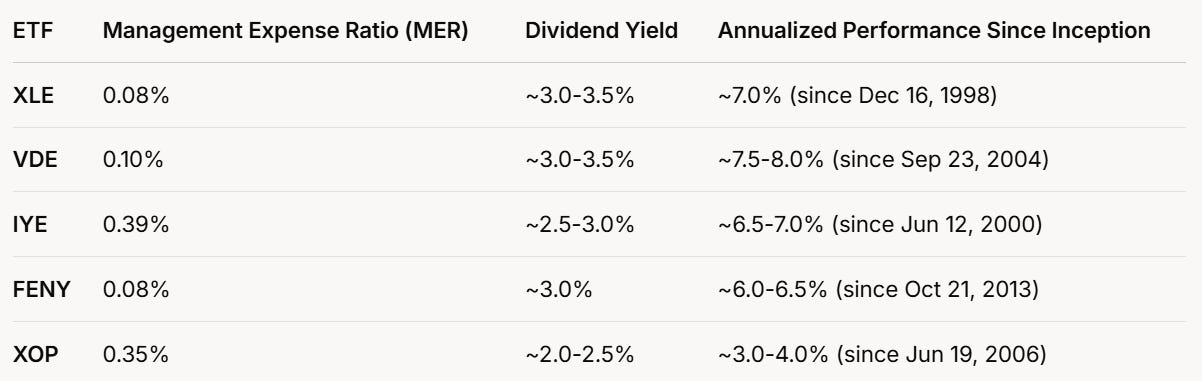
If you're looking for alternatives to the XLE ETF, here are some options that also focus on the energy sector:
Vanguard Energy ETF (VDE): Tracks the MSCI US Investable Market Energy 25/50 Index, offering broad exposure to U.S. energy companies across large-, mid-, and small-cap segments.
iShares U.S. Energy ETF (IYE): Similar to XLE, this ETF focuses on large-cap U.S. energy companies but has a slightly higher expense ratio.
Fidelity MSCI Energy Index ETF (FENY): Tracks the MSCI USA IMI Energy Index, providing exposure to U.S. energy companies across all market caps.
SPDR S&P Oil & Gas Exploration & Production ETF (XOP): Unlike XLE, this ETF emphasizes oil and gas exploration and production companies, providing a more niche focus within the energy sector.
This is a comparison of the XLE ETF and similar alternatives, focusing on their Management Expense Ratios (MER), yields, and annualized performances.
Target Investors
The Energy Select Sector SPDR Fund (XLE) ETF is designed to appeal to a specific group of investors based on its focus and characteristics. Here are the primary target investors:
Sector-Specific Investors: Those who want to focus on the energy sector, including oil, gas, and energy equipment and services companies.
Long-Term Growth Seekers: Investors who believe in the long-term growth potential of the energy sector, driven by factors like global energy demand and technological advancements.
Dividend Income Seekers: With its attractive dividend yield, XLE appeals to investors looking for a steady income stream.
Cost-Conscious Investors: The ETF's low expense ratio makes it a cost-effective choice for those seeking energy sector exposure.
Risk-Tolerant Investors: Given its concentrated exposure to the energy sector, XLE is suitable for those who can handle higher volatility and sector-specific risks.
Institutional and Retail Investors: Its high liquidity and large assets under management make it appealing to both individual and institutional investors.
Short-Term Traders: Given its high liquidity and low bid-ask spreads, XLE attracts traders who seek to take advantage of short-term price movements in the energy sector.
The target investors for XLE are those seeking targeted exposure to the U.S. energy sector—ranging from tactical traders and sector enthusiasts to income-focused or risk-tolerant individuals—rather than those building broadly diversified, long-term buy-and-hold portfolios.
Reasons to Invest in XLE
Sector Exposure: XLE provides targeted exposure to the energy sector, which can benefit from rising oil prices and global energy demand.
Dividend Income: The ETF offers an attractive dividend yield, making it appealing for income-focused investors.
Low Expense Ratio: With a management expense ratio (MER) of 0.08%, XLE is a cost-effective way to invest in the energy sector.
Top Holdings: It includes industry leaders like Exxon Mobil and Chevron, which are well-established and financially stable companies.
Liquidity: XLE is highly liquid, ensuring ease of buying and selling without significant price impact.
Inflation Hedge: Energy stocks often perform well during inflationary periods, providing a potential hedge against rising prices.
Cyclical Upside: Energy stocks often perform well during economic recoveries or periods of inflation, as demand for oil and gas rises. If you anticipate such conditions, XLE could benefit from this cyclicality.
Global Energy Dependence: Despite the growth of renewables, global economies still heavily rely on traditional energy sources, ensuring continued demand for the sector.
Reasons Not to Invest in XLE
High Volatility: The energy sector is highly sensitive to oil price fluctuations, geopolitical events, and regulatory changes, leading to increased volatility.
Concentration Risk: XLE is heavily concentrated in a single sector, lacking diversification across other industries.
Environmental Concerns: Investors focused on ESG (Environmental, Social, and Governance) principles may avoid XLE due to its focus on fossil fuels.
Transition to Green Energy: The global push toward renewable energy and carbon neutrality poses a long-term risk to traditional energy companies. XLE’s heavy reliance on fossil fuel-related firms could lag as investors and governments prioritize sustainable alternatives.
Market Cyclicality: The energy sector is cyclical, meaning its performance can vary significantly depending on economic conditions.
Commodity Price Dependency: XLE’s performance is tied closely to volatile commodity prices, which are influenced by unpredictable factors like OPEC decisions and weather patterns.
Limited Growth Potential: As a mature sector, energy may offer lower growth potential compared to emerging industries like technology or renewable energy.
Interest Rate Sensitivity: Rising interest rates can hurt energy stocks, particularly those with high debt levels (common in the sector).

Consider joining DiviStock Chronicles’ Referral Program for more neat rewards!Please refer to the details of the referral program.