

For readers who want a deeper introduction to how Exchange‑Traded Funds (ETFs) work and how to analyze them, I recommend checking out my earlier post that covers the core concepts and analysis framework.

BMO Short-Term US TIPS Index ETF (ZTIP) - Snapshot
Overview
The BMO Short-Term US TIPS Index ETF (ZTIP)1 provides Canadian investors with direct exposure to short-term U.S. Treasury Inflation-Protected Securities (TIPS). Managed by BMO Asset Management Inc. and traded on the Toronto Stock Exchange (TSX) in Canadian dollars, ZTIP aims to shield investors’ principal and purchasing power against inflation while minimizing interest rate duration risk.
Because the principal value of TIPS adjusts directly with changes in the U.S. Consumer Price Index (CPI), ZTIP offers a defensive, capital-preservation solution within fixed-income allocations.
Investment Strategy
ZTIP seeks to replicate, to the extent possible, the performance of the Bloomberg U.S. Government Inflation-Linked 0-5 Year Bond Index, net of management expenses.
To execute this strategy:
The fund invests primarily in inflation-protected bonds issued by the U.S. Treasury with remaining maturities between 0 and 5 years.
It may utilize full replication or a sampling methodology to hold constituent debt securities.
The short maturity profile (typically maintaining a weighted average duration around 2.3–2.5 years) significantly reduces price sensitivity to fluctuations in interest rates compared to broad aggregate or long-term bond funds.
Note that unhedged CAD units of ZTIP carry currency exposure to the U.S. Dollar relative to the Canadian Dollar.
Buying unhedged units of ZTIP means taking on a dual position: you are long U.S. inflation-protected bonds and long the U.S. Dollar relative to the Canadian Dollar.
When the U.S. Dollar Strengthens (CAD Weakens): Your total return increases. Converting the USD-denominated TIPS back into weaker Canadian Dollars yields a currency gain on top of the bond’s performance.
When the Canadian Dollar Strengthens (USD Weakens): Your total return decreases. Converts back into fewer Canadian Dollars, creating a currency drag—even if the underlying bond price didn’t change.
Top Holdings
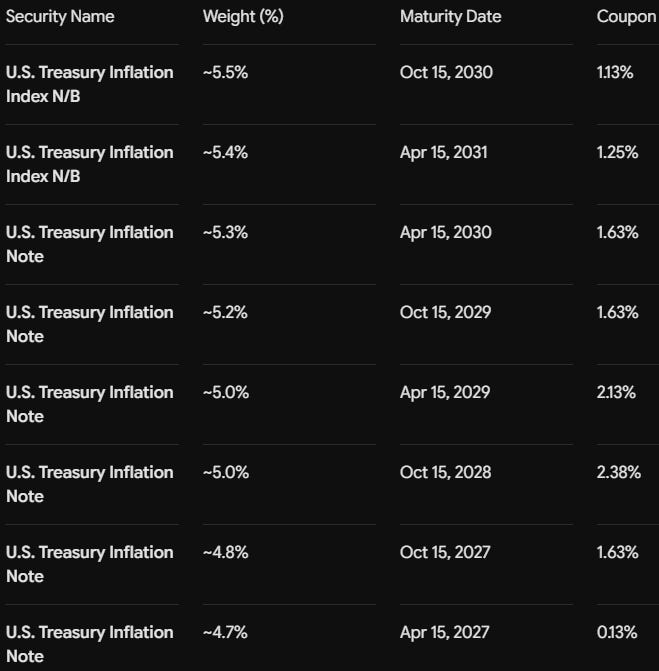
The portfolio is entirely composed of short-dated U.S. Treasury Inflation-Protected Securities. Here’s an example of a composition:
Sector Allocation
Because ZTIP holds underlying debt guaranteed exclusively by the U.S. Federal Government, its sector allocation is almost entirely concentrated in sovereign government debt with minimal residual cash balances:
U.S. Treasury / Sovereign Government Debt: ~95.6%
Cash & Cash Equivalents: ~4.4%
Risk Level
LOW-to-MEDIUM
Near-Zero Credit Risk: Backed by the full faith and credit of the U.S. Treasury, making default risk practically non-existent.
Low Interest Rate Sensitivity: By holding bonds maturing in 0 to 5 years, the fund maintains a short duration (~2.36 years). A 1% rate hike impacts unit prices by roughly 2.36%, offering far greater stability than traditional long-term bond funds.
Currency Volatility: As an unhedged CAD ETF, returns fluctuate with the CAD/USD exchange rate. A strengthening Canadian Dollar can lower unit values even if underlying TIPS prices remain stable.
Expense Ratio
ZTIP’s management expense ratio (MER) is 0.17% per annum.
This means that for every $1,000 invested, the annual cost would be $1.70.
Dividend Yield
Unlike traditional dividend stocks or regular bond ETFs that offer stable payout percentages, ZTIP's historical yield acts as a moving barometer of U.S. inflation—rising when CPI surges and tapering off when inflation cools.
High Inflation Years (2021–2022): As inflation spiked, annual distribution yields reached 6.0% to 8.0%+ because bond principal values were aggressively adjusted upward.
Normalized Inflation Years (2023–2025): As inflation cooled toward target levels, distribution yields stabilized back into the 3.5% to 4.8% range.
Baseline Real Yield: If inflation stays low or steady, the yield gravitates toward its underlying coupon yield to maturity (roughly 2.0% to 2.5% above base inflation).
This means that for every $1,000 invested, you can expect to receive approximately $20 to $80 in dividends over a year, depending on where the U.S. Consumer Price Index (CPI) is in the cycle.
Similar Alternatives
For Canadian investors evaluating inflation-protected fixed income options, three comparable ETFs include:
iShares 0-5 Year TIPS Bond Index ETF (XSTP): A direct TSX-listed competitor managed by BlackRock Canada. Like ZTIP, XSTP tracks short-term (0–5 year) U.S. TIPS. It is offered in Canadian-dollar-hedged units (XSTP) as well as unhedged versions (XSTP.U).
BMO Real Return Bond Index ETF (ZRR): An alternative offered by BMO that focuses exclusively on Canadian federal inflation-protected debt (Real Return Bonds). Unlike ZTIP, which holds short-dated U.S. paper, ZRR holds mid-to-long term Canadian government bonds, carrying higher duration/interest-rate risk but zero foreign exchange exposure.
iShares 0-5 Year TIPS Bond ETF (STIP): The U.S.-listed parent fund issued by BlackRock trading on NYSE Arca in USD. It provides identical underlying exposure to short-term TIPS at an ultra-low expense ratio, though it requires Canadian investors to hold USD or manage currency exchange fees.
Target Investors
Inflation-Conscious Investors: Individual portfolio holders looking to protect their real purchasing power against rising consumer prices without taking on equity market risk.
Risk-Averse Fixed Income Allocators: Conservative investors seeking fixed income allocations with extremely high credit rating backing.
Capital Preservation Focused Retirees: Investors nearing or in retirement who require low volatility, stable quarterly distribution income, and protection from unexpected surges in living costs.
Investors Managing Duration Risk: Fixed-income buyers seeking real yield protection who want to avoid the high price volatility inherent in long-duration bond funds during changing rate environments.
Reason to Invest…
Direct Inflation Protection: The principal value of underlying bonds scales directly with increases in official CPI metrics, ensuring your capital keeps pace with inflation.
Low Duration Volatility: The short 0–5 year maturity spectrum minimizes price sensitivity when broad benchmark interest rates fluctuate.
Pristine Credit Quality: Fully backed by the U.S. Federal Government, eliminating default credit risk.
Low Fee Structure: Cost-effective management expense ratio makes it a lean option for fixed income exposure.
Quarterly Cash Distributions: Provides regular quarterly income payouts derived from interest coupons and inflation adjustments.
Convenient TSX Access: Allows Canadian investors to purchase U.S. inflation protection in CAD without necessity for currency conversion trades on foreign exchanges.
High Portfolio Liquidity: Underlying U.S. Treasury securities represent one of the most liquid fixed-income asset classes globally.
Diversification Benefits: Shows low historical correlation with traditional equities and corporate debt securities, providing defensive balance.
Reason Not to Invest…
Currency Risk Exposure: Unhedged CAD units fluctuate with shifts in the CAD/USD exchange rate, which can erode returns if the Canadian Dollar appreciates sharply.
Lower Yield in Low-Inflation Regimes: When inflation rates remain flat or drop into deflationary territory, yields and distribution income decrease.
Drag During Equity Bull Markets: As a conservative fixed-income instrument, total returns will lag behind broad equity markets during strong economic expansions.
Interest Rate Volatility Potential: While lower than long bonds, rapidly rising short-term interest rates can still cause minor temporary capital losses on underlying price.
Tax Inefficiency in Non-Registered Accounts: Inflation adjustments and bond interest payouts are taxed as regular income rather than preferred capital gains or eligible dividends if held outside TFSA/RRSP accounts.
Real Return Cap: Real yields on Treasury inflation-protected securities can be modest depending on prevailing market pricing at the time of purchase.
Lack of Growth Upside: The fund offers no corporate earnings growth or dividend growth drivers found in equity or dividend-focused ETFs.
Limited Local Exposure: Focuses purely on U.S. inflation metrics (US CPI) rather than direct Canadian domestic inflation statistics (Canadian CPI).
● DiviStock Chronicles is built for people who want to grow their wealth through dividend investing but don’t want to get lost in jargon or hype. My goal is simple: break things down clearly, stay honest about the risks, and help you build confidence as you navigate your own financial path. All analysis is human‑led, supported by AI tools like Microsoft CoPilot, Google Gemini, and xAI’s Grok, but the perspective is grounded in real‑world experience and common sense.