


For individuals seeking to learn about analyzing Exchange-Traded Funds (ETFs), I suggest reviewing my earlier post that explains the fundamentals of ETFs and the analysis process.

iShares MSCI Australia ETF (EWA) - Snapshot
Overview
The iShares MSCI Australia ETF (EWA)1 seeks to track the investment results of the MSCI Australia Index, which measures the performance of the Australian equity market. Launched on March 12, 1996, and managed by BlackRock, EWA provides investors with targeted exposure to large- and mid-cap Australian stocks across various sectors, offering a straightforward way to gain access to Australia's economy without the need for individual stock selection.
Investment Strategy
EWA employs a passive investment strategy, replicating the MSCI Australia Index through full replication or sampling techniques. The index includes approximately 47 large- and mid-capitalization companies listed on the Australian Securities Exchange, weighted by free-float-adjusted market capitalization. The fund undergoes periodic rebalancing to ensure alignment with the index, focusing on broad market representation while minimizing tracking error.
Top Holdings
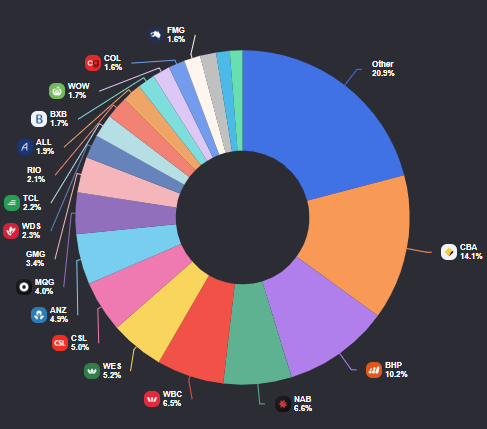
EWA features a concentrated portfolio where the top 10 holdings account for approximately 61.6% of its assets, emphasizing Australia's dominant financial and resource sectors. Some of its major holdings include:
Commonwealth Bank of Australia (CBA): Australia’s largest bank, offering a wide range of financial services including retail, business, and institutional banking across the Asia-Pacific region.
BHP Group Ltd (BHP): A global mining and resources company specializing in the extraction of iron ore, copper, and coal, with operations spanning multiple continents.
Westpac Banking Corporation (WBC): One of Australia’s “Big Four” banks, providing comprehensive banking and financial solutions to individuals, businesses, and institutions.
National Australia Bank Ltd (NAB): A major financial institution focused on business banking, wealth management, and personal finance across Australia and New Zealand.
Wesfarmers Ltd (WES): A diversified conglomerate with interests in retail (including Coles and Bunnings), chemicals, energy, and industrial sectors.
Sector Allocation
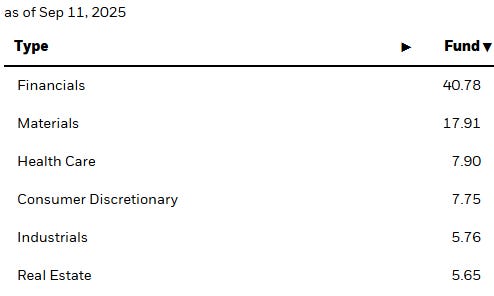
EWA is heavily weighted toward Financial Services and Basic Materials, reflecting Australia's economic structure:
Risk Level
MEDIUM-to-HIGH – due to exposure to sector concentration risks, currency fluctuations, and macroeconomic cycles affecting Australia’s financial and commodity sectors. Morningstar rates it 4 out of 5 on its risk scale, highlighting above-average volatility compared to diversified global funds.
Performance
Since its inception on March 12, 1996, EWA has delivered an annualized return of 7.58% as of September 12, 2025. This performance reflects the long-term growth of the Australian market, tempered by periods of commodity cycles and currency impacts.
Expense Ratio
EWA’s management expense ratio (MER) is 0.50% per annum.
This means that for every $1,000 invested, the annual cost would be $5.
Dividend Yield
EWA has maintained a historical average dividend yield of approximately 3.2% over its lifetime, with semi-annual distributions.
This means that for every $1,000 invested, you can expect to receive approximately $32 in dividends over a year, assuming the yield remains constant.
Similar Alternatives
Here are three ETFs offering comparable exposure or diversification:
Franklin FTSE Australia ETF (FLAU): A low-cost alternative tracking the FTSE Australia Capped Index, offering similar broad exposure to large- and mid-cap Australian stocks with a focus on cost efficiency.
First Trust Australia AlphaDEX ETF (FAUS): This actively selected fund uses a factor-based approach to target Australian equities with strong fundamentals, emphasizing alpha generation over pure indexing.
WisdomTree Australia Dividend Fund (AUSE): A dividend-weighted ETF that prioritizes high-yielding Australian companies, providing income-focused exposure to the market.
Target Investors
Global Diversifiers: Investors seeking exposure beyond North America, particularly to developed Asia-Pacific markets.
Dividend Seekers: Those looking for consistent semi-annual income from established companies.
Commodity-Linked Investors: Individuals interested in benefiting from Australia’s resource-rich economy.
Long-Term Holders: Investors with a multi-year horizon who can tolerate short-term volatility.
Currency Hedgers: Those wanting indirect exposure to the Australian dollar.
Sector Allocators: Portfolio builders aiming to overweight financials and materials.
Passive Investors: Those preferring low-cost, index-tracking strategies.
Retirement Planners: Investors seeking international diversification in retirement accounts.
Reason to Invest…
Broad Market Access: Gain instant diversification across Australia's top companies without researching individual stocks.
Economic Stability: Benefit from Australia's robust regulatory environment and AAA credit rating for added security.
Resource Sector Upside: Capitalize on the country's leadership in mining and exports during global recovery phases.
Currency Diversification: Hedge against USD strength by holding AUD-denominated assets.
Dividend Reliability: Enjoy consistent payouts from mature firms with strong balance sheets.
Liquidity Benefits: Trade easily on major U.S. exchanges with high daily volume.
Long-Term Growth Potential: Tap into Australia's innovation in healthcare and technology alongside traditional strengths.
Passive Simplicity: Avoid the complexities of direct foreign investing with a hands-off approach.
Inflation Hedge: Leverage commodity ties that often perform well in inflationary periods.
Portfolio Balance: Complement growth-oriented holdings with value-driven Australian equities.
Reason Not to Invest…
Currency Risk Exposure: Fluctuations in the AUD/USD exchange rate can erode returns for non-hedged U.S. investors.
Commodity Dependency: Vulnerability to global price swings in iron ore, coal, and other exports.
Limited Tech Exposure: Underweight in high-growth sectors like technology compared to global benchmarks.
Geopolitical Sensitivities: Ties to China trade relations introduce external policy risks.
Higher Fees Relative to Broader Funds: Costs exceed those of diversified international ETFs.
Volatility from Rates: Interest rate changes in Australia can impact banking-heavy holdings.
Smaller Universe: Only 47 holdings limit depth compared to larger global indices.
Tax Complications: Foreign withholding taxes on dividends may reduce net income for U.S. taxpayers.
Market Concentration: Heavy financials weighting amplifies sector-specific downturns.
Opportunity Cost: Miss out on faster-growing emerging markets or U.S. tech rallies.

Consider joining DiviStock Chronicles’ Referral Program for more neat rewards!Please refer to the details of the referral program.